

Barley (Hordeum vulgare L.) is widely cultivated and distributed in the Eastern Asian region (Ikeguchi et al., 2014). It is one of the widely consumed cereals (Ferreres et al., 2009) and has become main cereal grains since ancient time. It has long been cultivated and particularly used for feeding livestocks (Kamiyama et al., 2012). Additionally, it has been used as human food, especially bread and cake (Ikeguchi et al., 2014). The young barley leaf extract contains phenolic and isoflavonoid compounds which have been shown to exhibit antioxidative activity in the lipid peroxidation system and is well-known for being good natural source of various vitamins and minerals (Yu et al., 2003). Since the benefits of barley leaves have been discovered and identified, barley meals and fractions are increasingly used as functional food, baked product ingredient (Kamiyama et al., 2012; Ferreres et al., 2009). In Japan, young barley leaves are prepared as material of green-colored drink named: ‘Aojiru’ (Ikeguchi et al., 2014), and ‘Barley sprouts’ in Korea (Na, 2014; Seo, 2015).
Recently, scientists have found a new alternative method for plant protection for improving bioactive compound contents (Szymanowska et al., 2015). There are several methods to improve the quality in fresh vegetables, including genetic modification and agronomical manipulation (particularly fertilization) (Złotek et al., 2014). Elicitation might be a good method to induce the synthesis of bioactive secondary metabolites (Dueñas et al., 2015). The reason for this is that it may enhance bioactive compounds in plants, thereby producing secondary metabolite by rapidly responding to stress/elicitor. Therefore, quality of edible plant may be improved by elicitation (Złotek et al., 2014).
Salicylic acid (SA) is a phenolic compound of a hormonal nature which is produced by plants. It shows a crucial role in response to some abiotic stresses (Ghasemzadeh et al., 2013). SA and methyl jasmonate (MJ) are endogenous plant growth substance which plays an important role in growth, development and response to the environmental stress of plants (Yao et al., 2005). Amino acid liquid fertilizer (ALF) treatment in grass reportedly enhanced chlorophyll content in the grass. Additionally, growth and grass quality were better too. It also showed high capacity to survive in poor environments (Kim et al., 2014). Microbial metabolism activator (MMA) is consisted of microbial metabolism products such as streptomyces and bacillus, water-soluble boric acid (0.05%) and molybdenum (Mo, 0.005%). It plays an important role in improving plant growth and reproduction by enforcing the outer defense system with physiologically active substance synthesized. It may also enhance the effectiveness of microorganisms activated for higher quality and growth of seed and forage thereby increasing the yield of crop and forage grasses.
Application of elicitors in promoting crop quality had been studied and published in the past (Złotek et al., 2014; Pérez- Balibrea et al., 2011). There has not been any comparative studies regarding the effect of SA, MJ, ALF and MMA on the growth and bioactivity of barley. This study was carried out for evaluating the effects of four elicitors (SA, MJ, ALF and MMA) at various concentrations on growth parameters and antioxidant activity of barley.
MATERIALS & METHODS
Seed germination
This study was carried out in Kangwon National University, Chuncheon Campus, Department of Bio-Health Technology, South Korea. Barley seeds were collected from a farmer’s field in east-southern area of Gangwon province in the middle of June 2014. Total fifteen trays (water drainable), laboratory tissues, elicitor solutions and barley seeds were prepared. Soil-free germination was obtained by using laboratory tissues (paper topping methods) between December 2014 and January 2015. Germination process and elicitor treatment were conducted inside the greenhouse in which temperature was controlled. The average temperature in the greenhouse during the growing period was 20°C. Vinyl was covered on the trays to maintain humidity before and after elicitor appilication. The humidity inside cover ranged 60~78% during growing period. The seeds were frequently humidified by water in order to prevent dryness. After 10 days of germination, elicitor solutions in various concentrations were applied to young barley seedling (YBS).
Elicitor solution preparation and treatment
Four different types of elicitors: MJ, SA, ALF and MMA solutions were prepared at various concentrations. SA was diluted at varying concentrations of 1.38 mg/L, 13.8 mg/L, 69.06 mg/L and 138.12 mg/L; MJ was diluted in 0.25% ethanol to prepare different concentrations (1 ml/L, 5 ml/L, 10 ml/L and 20 ml/L); ALF was also diluted at four different concentrations (1 ml/L, 2 ml/L, and 3 ml/L); similarly, MMA was diluted at three different concentrations-(1 ml/L, 2 ml/L and 3 ml/L). Deionized water was used for all the dilutions. Elicitation was achieved by equal amount of foliar irrigation to each YBS cultivated in the tray by using watering cans and irrigations were applied twice. The first elicitation was conducted 10 days after germination (DAG), then all treatments were daily watered by normal water. The second elicitation was done at 13 DAG. After elicitations, YBS was covered by thin film in order to maintain high humidity. Water was only applied as a control. YBS was harvested at 16 DAG (3 days after second elicitation). At the end, growth parameters (seedling length, fresh weight of 10 seedlings) were measured. Total phenolic content was estimated and Chlorophyll content, carotenoid content as well as antioxidant activity was determined.
Preparation of young barley seedlings extraction
YBS samples were collected and dried at a temperature of 40°C for 6 days. They were ground using blender and one gram of each sample was soaked with 200 ml of 60% methanol for 24 hours in the room temperature. The extracts were filtered through advantec 70 mm filter paper (Tokyo Roshi Kaisha, Ltd, Japan) and dried using a vacuum rotary evaporator (N-100, Tokyo RIKAKIKAI CO., LTD. Japan) in a 40°C water bath. Dried samples were weighed and kept at -20°C for further analysis.
Determination of chlorophyll, carotenoid content
The 60 mg of fresh YBS was mixed and blended with 6 ml of 95% ethanol, then the mixture was filtered and centrifuged for 15 min at 2900 g. The supernatant was collected and measured at a UV Spectrophotometry at 665, 649 and 470 nm of wavelength. Chlorophyll a, chlorophyll b and carotenoid content was calculated by the following equation (Lichtenthaler and Wellburn, 1983):.
chl a = chlorophyll a, chl b = chlorophyll b, and car = total carotenoids; in μg/mg fresh weight
Estimation of total polyphenol content
Total phenolic content (TPC) of YBS was estimated by the Folin-Ciocalteu assay. In brief, a sample aliquot of 0.2 ml of extract (1 mg/mL) was added to the test tube containing 0.2 ml of phenol reagent (1 M). The volume was increased by adding 1.8 mL of deionized water and the solution was vortexed and left for 3 min for reaction. Furthermore, 0.4 mL of Na2CO3 (10% in water, V/V) was added and the final volume (4 mL) was adjusted by adding 1.4 mL of deionized water. The absorbance was measured at 725 nm after incubation for 1 hour at room temperature. The TPC was calculated from a calibration curve (R2 = 0. 999) using tannic acid as standard and expressed as mg of tannic acid equivalent (TAE) per g dry weight (dw).
DPPH free radical scavenging activity
The antioxidant activity of YBS extracts was determined on the basis of the scavenging activity of the stable 1,1-diphenyl- 2-picryhydrazyl (DPPH) free radical according to the method described by Ghimeray et al. (2014) with slight modifications. Briefly, 1ml of the extract at different concentrations (2, 4 and 8 mg/mL) was added to 3 mL (100% of methanol) of DPPH. The mixtures were shaken vigorously and left to stand at room temperature in the dark for 30 minutes. The absorbance was measured at 517 nm in a spectrophotometer (Model: UV-1800 240 V, Shimadzu Corporation, Kyoto, JAPAN). All determinations were performed in triplicate and the scavenging activity of the extracts was calculated against a blank:
Where, A0 and A1 were the absorbance of the control and the test sample, respectively.
Statistical analysis
All data were expressed as the mean value ± standard deviation (SD) of each experimental group (n=3). The Differences in the mean values among samples were analyzed by one-way analysis of variance (ANOVA) and Duncan’s multiple tests using SPSS 16.0 (SPSS Inc., USA). Statistical significance was considered at P< 0.05.
RESULTS & DISCUSSION
Growth parameters
Growth parameter (length and fresh weight) of YBS was measured at 16 DAG. Ten seedlings were randomly selected for measurement. Length and fresh weight of YBS showed significant difference among the treatments. Elicitor treated YBS increased by 17.7~50.4% in length and 0.8~21.9% in fresh weight as compared to the control.
Length of young barley seedlings
Among treatments, MJ 1 ml/L gave the longest length for YBS with 12.33 cm while it was the lowest under control treatment (8.2 cm). SA 1.38 mg/L and ALF 2 ml/L were respectively 12.29 cm and 12.05 cm. MJ and SA were found to be the most effective elicitor to increase seedling length in the lowest concentration (Table 1). Besides ALF treated-YBS, other elicitor treated ones (SA, MJ and MMA) decreased the seedling length at higher concentration of elicitor. These results were in agreement with previous studies. The SA application influences on various plant processes, including plant growth and yield. The effects in enhancing plant growth and photosynthesis rate were commonly found in lower SA concentration (Ghasemzadeh and Jaafar, 2013). Akhtar et al. (2013) reported that foliar application of SA at 100 mg/L significantly improved all the growth parameters in all cultivars under saline condition. While, the level of SA at 200 mg/L and 300 mg/L did not show appreciable performance under normal and saline condition.
Table 1.
Growth parameters of young barley seedlings treated with elicitors.
| Treatment | Concentration | Length (cm) | Fresh weight (g) |
|---|---|---|---|
| Control | Water only | 8.2±1.39cd | 1.28±0.07b |
| SA (mg/L) | 1.38 | 12.29±1.91a | 1.50±0.14a |
| 13.8 | 11.44±2.88b | 1.53±0.20a | |
| 69.09 | 11.01±2.43b | 1.48±0.14ab | |
| 138.12 | 9.73±1.00c | 1.39±0.05ab | |
| MJ (ml/L) | 1 | 12.33±1.5a | 1.44±0.06ab |
| 5 | 10.48±1.46bc | 1.55±0.08a | |
| 10 | 9.77±2.14c | 1.29±0.11b | |
| 20 | 9.65±2.02c | 1.29±0.02b | |
| ALF (ml/L) | 1 | 11.76±1.69b | 1.47±0.06ab |
| 2 | 12.05±1.49a | 1.53±0.13a | |
| 3 | 11.72±2.85b | 1.56±0.03a | |
| MMA (ml/L) | 1 | 11.24±1.76b | 1.36±0.18ab |
| 2 | 10.54±1.29bc | 1.51±0.04a | |
| 3 | 10.45 1.85bc | 1.45±0.09ab | |
Fresh weight of young barley seedlings
Fresh weight of YBS treated with elicitors was also significantly different among the treatments (Table 1). ALF 3 ml/L treated-YBS gaved the highest fresh weight (1.56 g) while the control gave the lowest (1.28 g). MJ 5 ml/L, ALF 2 ml/L and SA 1.38 mg/L gave 1.55 g, 1.53 g and 1.50 g respectively. The highest fresh weight was obtained from ALF in the highest concentration. However, other elicitors treated-YBS (SA, MJ, and MMA) increased the fresh weight at second lowest concentration of elicitors, then was decreased again in the higher concentration.
ALF has also been applied as fertilizer for Creeping Bentgrass cultivation. Application of ALF showed the positive effect on the dry weight of creeping bentgrass as compared to that of non-fertilized and control (Kim et al., 2014). Additionally, growth and grass quality were increased by using amino acid fertilizer (Kim et al., 2003; Kim et al., 2012). However, significant difference was not observed among the elicitor treated samples. Elicitation has been widely used not only to increase production, but also to induce de novo synthesis of secondary metabolites in vitro plant cell culture. Growing interest in utilizing elicitation as a method for improving the quality of whole edible plant has been increasing recently (Złotek et al., 2014). Thus, elicitation to the YBS might be a useful method to increase its growth parameters, particularly fresh weight.
Determination of chlorophyll, carotenoid content
Chlorophyll content in YBS treated with SA, MJ, ALF and MMA was significantly different (Table 2). SA 138.12 mg/L treated -YBS showed the highest contents in chl a (8.57 μg/mg) and chl b (3.83 μg/mg) contents as compared to those of the control (7.14 μg/mg and 3.25 μg/mg, respectively). Chl a, chl b contents (7.63 μg/mg and 3.61 μg/mg respectively) in SA 69.09 mg/L treated-YBS were the second highest. Regarding all, chlorophyll content was decreased as compared to that of control. However, ALF 3ml/L treated YBS showed negligibly increased content of chlorophyll b gaved (3.33 μg/mg) which was not significantly different to that of control (chlorophyll b 3.25 μg/mg) .
Table 2.
Chlorophyll content in young barley seedlings treated with elicitors.
| Treatment | Concentration | Chlorophyll content (μg/mg) | Carotenoid content (μg/mg) | |
|---|---|---|---|---|
| Chl a | Chl b | Car | ||
| Control | Water only | 7.14±0.14b | 3.25±0.02b | 1.36±0.11b |
| SA (mg/L) | 1.38 | 4.98±0.10de | 2.55±0.01c | 0.89±0.01e |
| 13.8 | 5.69±0.12d | 2.81±0.00bc | 0.96±0.13e | |
| 69.09 | 7.63±0.15b | 3.61±0.03b | 0.95±0.54e | |
| 138.12 | 8.57±0.17a | 3.83±0.01a | 1.52±0.11ab | |
| MJ (ml/L) | 1 | 4.87±0.09de | 2.57±0.00c | 1.62±0.67a |
| 5 | 5.14±0.10d | 2.61±0.00c | 0.94±0.02e | |
| 10 | 6.92±0.14bc | 3.32±0.01b | 1.37±0.01b | |
| 20 | 5.53±0.11d | 2.89±0.00bc | 1.13±0.01d | |
| ALF (ml/L) | 1 | 4.47±0.09e | 2.50±0.01c | 0.84±0.00e |
| 2 | 6.07±0.12c | 2.91±0.00bc | 1.19±0.01d | |
| 3 | 7.00±0.14b | 3.33±0.01b | 1.41±0.02b | |
| MMA (ml/L) | 1 | 6.77±0.14c | 3.19±0.01b | 1.31±0.02c |
| 2 | 5.62±0.11d | 2.79±0.01bc | 1.13±0.01d | |
| 3 | 4.51±0.09e | 2.43±0.01c | 0.89±0.01e | |
The carotenoid content in elicitor treated-YBS was also shown in Table 2. The highest carotenoid content was found in MJ 1 ml/L (1.62 μg/mg). The content of carotenoid in SA 138.2 mg/L and AFL 3 ml/L treated-YBS were 1.52 μg/mg and 1.41 μg/mg respectively. The other treatments reduced the carotenoid content as compared to that of control.
Kim et al. (2014) mentioned that the fertilizer, which included amino acids, saponins and Chitosan as component showed high efficiency in improving the quality and chlorophyll content of the grass. However, The lowest chlorophyll, carotenoid content was found in the ALF 1 ml /L treated YBS (4.47 μg/mg, 2.5 μ g/mg and 0.84 μg/mg of Chl a, Chl b, Car content respectively) in this study.
Total polyphenol content (TPC)
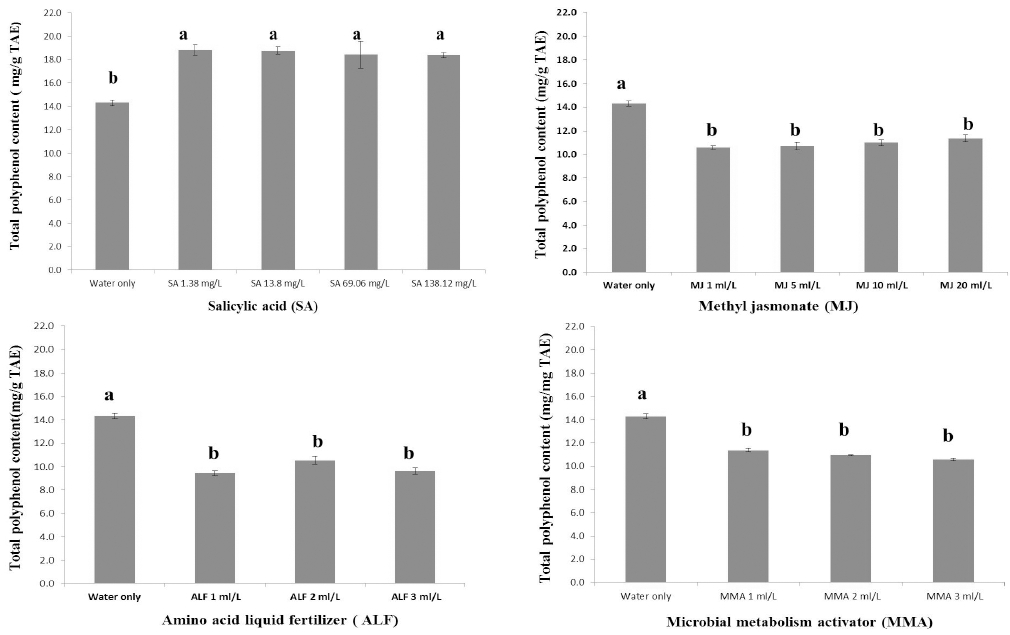
Among these elicitation treatments, SA treatment was found to be better for increased level of TPC, whereas the lowest TPC was found in ALF treated-YBS (Fig. 1). SA 1.38 mg/L showed the highest TPC among SA treated group (18.82 mg/g TAE) followed by 13.81 mg/L, 69.06 mg/L and 138.12 mg/L giving 18.767 mg/g, 18.424 mg/g and 18.38 mg/g of TAE respectively. While TPCs of ALF (1 ml/L, 2 ml/L and 3 ml/L) were found to be 9.46 mg/g, 10.536 mg/g and 9.619 mg/g TAE respectively. Even though the TPC was increased in SA treated YBS compared to the control, the TPC gradually decreased at the higher concentration of SA elicitation. The similar result was found in previous reports. Foliar application of SA to red amaranth enhanced the accumulation of bioactive compounds, polyphenol and antioxidant activity as compared to the control plant (Khandaker et al., 2009). However, higher biological and leaf yield was obtained with low concentration of SA application (Sedeghian et al., 2013). Total phenolics and specific individual phenolics would be increased by using proper elicitors and its concentration (Nair et al., 2013). Therefore, application of SA at 1.38 mg/L of concentration might be an appropriate elicitation for YBS.
DPPH free radical scavenging activity
DPPH free radical scavenging activity was determined at 2, 4 and 8 mg/ml of concentrations. The IC50 values were calculated and expressed in mg/ml of the extracts. The lower the IC50 value, the higher would be the DPPH free radical scavenging capacity of the extracts. The DPPH scavenging activity of YBS extracts was influenced by elicitation (Table 3). We found that SA 1.38 mg/L had highest DPPH inhibition which gaved the lowest IC50 value of 72 mg/mL as compared to that of the control (100.76 mg/mL) and other treatments while the lowest DPPH inhibition was found among ALF 1 ml/L treated-YBS which gaved the highest IC50 value of 128.08 mg/mL. Overall, SA and MMA treated-YBS showed better in DPPH inhibition at low concentration of elicitators, The inhibition was decreased with increase in the concentration of SA. Different trend was observed in ALF treated-YBS, in which higher inhibition was found in YBS at high concentration of ALF.
Table 3.
DPPH radical scavenging activity (%) of elicitor treated young barley seedlings extract.
| Treatment | Concentration | Dilution | IC50 | ||
|---|---|---|---|---|---|
| 2 mg/mL | 4 mg/mL | 8 mg/mL | (mg/mL) | ||
| Control | Water only | 15.90±1.23a | 25.73±0.8c | 41.17±0.95c | 100.76±2.05c |
| SA(mg/L) | 1.38 | 20.85±1.23a | 35.03±0.35c | 53.05±1.09a | 72.71±1.18de |
| 13.8 | 22.95±5.58a | 35.15±0.75a | 52.03±0.74a | 74.56±2.95de | |
| 69.09 | 17.94±0.3b | 31.26±1.7ab | 49.94±1.67ab | 79.71±3.72de | |
| 138.12 | 16.76±0.6b | 26.06±0.14bc | 39.25±1.23cd | 107.75±4.37c | |
| MJ(ml/L) | 1 | 12.54±0.54c | 22.25±0.68cd | 34.95±2.03d | 120.39±7.78b |
| 5 | 13.45±1.23c | 24.11±1.69c | 43.08±2.53c | 93.10±5.62cd | |
| 10 | 13.42±0.43c | 22.90±0.35cd | 39.72±0.79cd | 103.51±3.53c | |
| 20 | 11.89±0.1d | 21.28±0.56d | 35.97±0.35d | 115.09±2.37b | |
| ALF(ml/L) | 1 | 13.92±0.35c | 21.83±0.09d | 33.99±1.51d | 128.08±7.76a |
| 2 | 14.43±0.71c | 25.42±1.54c | 40.44±0.70c | 101.36±0.98c | |
| 3 | 17.01±1.2b | 29.41±0.52b | 47.06±1.18b | 85.33±1.80d | |
| MMA(ml/L) | 1 | 17.96±0.1b | 31.20±0.84ab | 53.38±0.55a | 73.73±0.92de |
| 2 | 15.34±0.8bc | 24.62±0.76c | 40.65±1.00c | 101.59±1.73c | |
| 3 | 15.25±0.7bc | 24.67±0.59c | 39.48±0.28cd | 105.43±2.40c | |
Sun et al. (2012) investigated that MJ and SA significantly increased the content of main health-promoting compounds and enhanced the antioxidant activity of Chinese kale. SA application to apple tree increased fruit number, shoot number and carotenoid content in the leaves. Moreover, fruit weight, superoxide dismutase and peroxidase activities, as well as chlorophyll, protein and proline levels increased significantly in response to SA treatment compared to the control. Thus, treating apple tree with SA may increase antioxidant enzyme activities (Unal et al., 2015).
In our study, SA 1.38 mg/mL gave highest value for both TPC and DPPH radical scavenging activity. In a comparative study conducted by Yu et al. (2015), among different cereals studied, buckwheat gave the highest amount of total phenolics, with highest DPPH radical scavenging activity. Our finding showed that the TPC and DPPH can be further augmented with the treatment of SA 1.38 mg/L.
CONCLUSION
Seedling length was found to be increased with MJ 1 ml/L and SA 1.38 mg/L treatments respectively. There was no significant Difference in fresh weight among the treatments. The highest Chl a and Chl b were obtained from SA 138.12 mg/L treated- YBS with 8.57 μg/mg and 3.83 μg/mg, respectively. The highest carotenoid content was found in MJ 1 ml/L (1.62 μg/mg), However, it had no significant difference with SA 138.12 mg/L (1.52 μg/mg). Therefore, SA 138.12 mg/L found to improve growth and increase both chlorophyll and carotenoid content. The highest total polyphenol content was found in SA treated- YBS. Likewise, SA 1.38 mg/L showed the highest DPPH radical scavenging activity among all the treatments. In conclusion, SA would be recommended for the production of better quality of barley seedling.