


Platycodongrandiflorum is a perennial plant with a taproot system that belongs to the family Campanulaceae. It’s tuberous root is used for food or medicine. The root of Platycodon grandiflorum contains saponin, inulin, phytosterin, platycodinin, etc., which are effective for treating hemolysis, coughing, phelgm, and fever (Lee, 1974; Takaki and Lee, 1972), and the pharmacological ingredients of Platycodon grandiflorum have been previously reported to be the triterpenoid saponin (Kubota et al., 1969; Akiyama et al., 1972).
The number and structure of chromosomes in plants are species dependant, change of which causes an alteration of the cell and plant body characters. Particularly, tetraploid plants have a larger cell volume than diploid plants, and therefore, tetraploid generally have large organs or stems (Cockerham and Galletta, 1976; Lapins, 1975). The stems are thicker and longer and leaves and flowers are larger than that of others plants (Kim et al., 2003). In addition to polyploidization, secondary metabolites such as saccharide in sugar canes, vitamin C in tomato and apple, and nicotine in tobacco leaf, tend to increase, and, sometimes, physiological characteristics such as virus resistance in radish (Hahn, 1969) and freezing resistance in mulberry tree (Park, 1994) have been improved prominently.
This study was performed to characterize the morphological and physiological characteritics of tetraploid and diploid variety of Platycodon grandiflorum and, to obtain basic data for cultivating a tetraploid variety with a high yield and content of functional substances.
MATERIALS & METHODS
Colchicine induced soaking treatment and growth investigation
Seeds of Platycodon grandiflorum harvested in 2014 in Muju were used as an experimental material. For seed treatment, 20 ml of 0, 0.01, 0.05, 0.1, and 0.5% colchicine aqueous solutions were put in 9 cm diameter petri dishes, on which two sheets of filter paper were placed each, and 50 grains of seeds were placed on them (Table 1). To accelerate germination, the seeds were left for 1, 3, 6, and 12 hours at 5°C. The treatment was repeated three times each. After the soaking treatment, each seed was cleaned three to four times by using sterilized water, and sown in ridging for which vermiculite and peat moss were mixed at 1:1 ratio before forcing the germination in a 25°C thermostatic chamber. Germination was examined when a cotyledon appeared, and when 6 or more foliage leaves appeared, the leaves were collected to check polyploidy. Based on polyploid evaluation, tetraploid and diploid Platycodon grandiflorum were managed according to the standard cultivation method of wild edible greens announced by Rural Development Administration. On September 5, 2015, the growth of the above-ground part, stoma, and photosynthesis were examined, and, on September 15, the underground part was harvested to investigate the yield including root length and diameter and fresh weight.
Table 1
Effect of colchicine on chromosome doubling and seed germination in Platycodon grandiflorum.
Investigation of number of chromosomes
The root apex (About 1 cm) of milk white color in fresh, Platycodon grandiflorum was collected and pre-treated with 0.05% colchicine solution for 2-3 hours at room temperature, before fixing it with 95% ethanol and glacial acetic acid mixed solution (3:1) in a refrigerator. The sample was soaked again in 1N HCI solution, and adjusted to 60°C via hydrolysis in a water tank with 120 rpm. Then the sample was soaked in 2% aceto-orcein solution and then the number of chromosomes was examined by using an optical microscope.
DNA content analysis by using flow cytometry
The leaves of each treatment group were cut around 0.5×0.5 cm in size, and after adding HR-A liquid (Patec Ltd, Germany), the tissues were mashed to extract DNA. With this solution, HR-B liquid (Patec Ltd, Germany) was added for dyeing. And then, the DNA content was examined using flow cytometry (Patec PA-1, Germany), and polyploidy was determined based on the result.
Determination of number of chloroplasts in a guard cell
To observe chloroplasts, the back of the leaves that collected from the middle part of the plant were separated and the hypodermis was cut out. The hypodermis was then soaked in iodine-potassium solution [1% (w/v) iodine, 2% (w/v) potassium iodide] for 2-3 hours for dyeing, and the dyed hypodermis was inspected using a microscope. The number of chloroplasts in a guard cell was averaged after examining 30 cells in leaves of three entities per repetition.
RESULTS & DISCUSSION
Effect of colchicine on seed germination of Platycodon grandifolium were listed in the Table 1. Germination rate decreased at higher concentration and longer soaking time. Especially, the highest (0.5%) and longest (12 hours) treatment exhibited the lowest germination rate (1.3%). Seven (7) tetraploid plants were obtained with concentration 0.05% for 3hour, 0.01% and 0.05 for 6 hour and 0.5% for 12-hour treatment, respectively. Except the above mentioned treatment groups, no tetraploid individuals were observed in any other treatment groups. Fig. 1
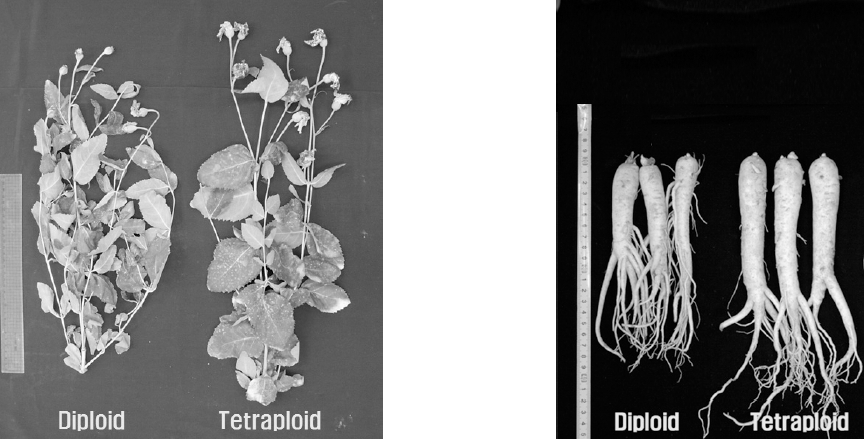
Fig. 1
The experimental materials collected from diploid and tetraploid varieties of Platycodon grandiflorum that were used in the present study.Seedling leaves grown from seeds of diploid Platycodon grandiflorum treated with colchicine were collected to measure the DNA content. As a result, tetraploid plants with double DNA content were induced (Fig. 2), and the numbers of chromosomes were 2n=2x=18 in diploid Platycodon grandiflorum, and 2n=4x=36 in tetraploid Platycodon grandiflorum (Fig. 3).

Fig. 2
Comparison of DNA contents in diploid and tetraploid varieties of Platycodon grandiflorum. The flow histograms show DNA measurements of nuclei from leaves.
Fig. 3
Somatic chromosomes in diploid (2n = 2x = 18) and tetraploid (2n = 4x = 36) of Platycodon grandiflorum.The above-ground growth of Platycodon grandiflorum following polyploidization is presented in Table 2.
Table 2
Comparison of growth characteristics between diploid and tetraploid varieties of Platycodon grandiflorum.
The plant height of the tetraploid variety (54.0 cm) was slightly higher than the diploid variety. The leaf length and width of the tetraploid variety were significantly increased as 10.2 cm and 7.3 cm, respectively compared to the diploid variety. The formation of leaf changed from lanceolate to ovate. The number of leaves was significantly higher in the diploid variety than in the tetraploid variety, but the total leaf areas per plant were similar both the diploid variety and tetraploid variety, with 963 cm2 and 941 cm2 respectively. The reason seems to be the length of the leaf and width of the tetraploid variety significantly larger than those of the diploid variety. The chlorophyll content in the tetraploid variety (16.7) was slightly higher than the diploid variety (Table 2, Fig. 1). While the stroma length and width were 49.6 μm and 29.1 μm, respectively, in the tetraploid just after polyploidization, and it was larger than those of diploid plants, the number of stroma (268/mm2 ) in diploid variety was significantly higher. The number of chloroplasts in a guard cell was 35.7 in the tetraploid variety that was doubled as the diploid variety (Table 3, Fig. 4). This result is highly consistent to the study that reported earlier in which the number of chloroplasts in a guard cell of potatoes significantly increased, according to the increase of polyploidy, with 12.2 in haploid, 18.4 in triploid, and 20.2 in tetraploid (Cho et al., 1994), and number of chloroplasts in a guard cell increased according to the increase of polyploidy in tobacco (Bae et al., 2001).
Table 3
Comparison of stoma characteristics between diploid and tetraploid varieties of Platycodon grandiflorum.
| Ploidy | Stomata size | Number of stomata (per mm 2 ) | Number of chloroplasts (per guard cell) | |
|---|---|---|---|---|
| length (μm) | width (μm) | |||
| Diploid | 31.4bz | 22.2b | 268a | 17.6b |
| Tetraploid | 49.6a | 29.1a | 180b | 35.7a |
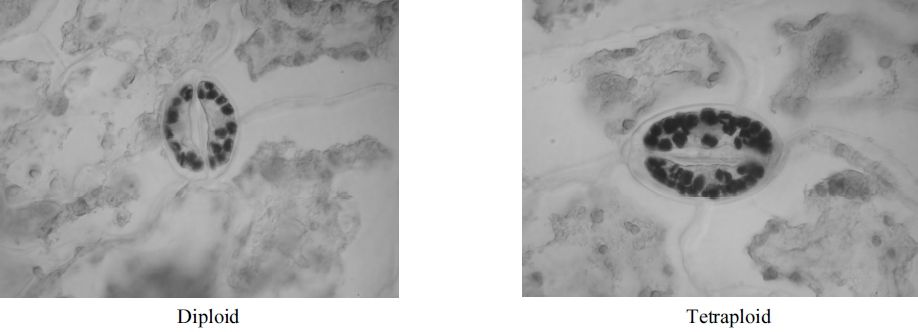
Fig. 4
Comparison of the number of chloroplasts per guard cell between diploid and tetraploid varieties of Platycodon grandiflorum.Table 4 presents the photosynthesis rate, stomatal conductance, intercellular CO2 concentration, and respiratory quotient (RQ) of diploid and tetraploid Platycodon grandiflorum. The photosynthesis rate was 13.4 μmol CO2·m-2 ·s-1 in the tetraploid variety, that was significantly (24%) increased compared to the diploid. However, there were no significant differences in stomatal conductance, intercellular CO2 concentration, and RQ, between the diploid variety and tetraploid variety of Platycodon grandiflorum. In mandarin, the chlorophyll content and photosynthesis rate are higher in the tetraploid variety than in the diploid variety (Song et al., 2011), and a similar tendency was observed in the present study. The photosynthesis speed of the diploid and tetraploid Platycodon grandiflorum linearly increased, according to the light strength, based on change in photosynthetic active radiation (PAR). The photosynthetic rate of the diploid variety peaked at PAR 500~1,000 μmol·m-2 ·s-1 , and that of the tetraploid variety at PAR 1,000~2,000 μmol·m-2 ·s-1 , but the rates were consistent afterward (Table 5). Similar results have been demonstrated in rice (Hidema et al., 1991) and soybeans (Kumura, 1969), and the high photosynthetic rate of the tetraploid variety in comparison to the diploid variety can be explained by the improved matter production in the tetraploid.
Table 4
Comparison of photosynthetic characteristics between diploid and tetraploid varieties of Platycodon grandiflorum.
Table 5
Comparison of photosynthetic rate according to the difference in photosynthetic active radiation (PAR) between diploid and tetraploid varieties of Platycodon grandiflorum.
The maximum photosynthesis rate and optimum light intensity according to polyploidy were examined by using a regression curve. The maximum photosynthetic rate of the diploid variety was 7.7 μmol CO2· m-2 ․·s-1 , and that of tetraploid 12.0 μmol CO2· m-2 ·s-1 , and the optimum light intensities of the diploid variety and tetraploid variety were Log 2.9950 μmol and Log 3.2723 μmol, respectively (Fig. 5).
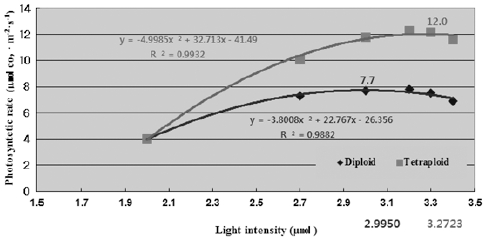
Fig. 5
Changes in net photosynthetic rate of diploid and tetraploid varieties of Platycodon grandiflorum.The floral characteristics of the diploid and tetraploid Platycodon grandiflorum are presented in Table 6. The numbers of flowers of the diploid and tetraploid Platycodon grandiflorum were 9.1 and 7.5, respectively, and there was no significant difference between the diploid and tetraploid flowers. However, the flower length and width of the tetraploid variety were significantly higher than those of the diploid variety suggesting that polyploidization increased the sizes of the organs or stem (Cockerham and Galletta, 1976; Lapins, 1975) as well as leaves and flowers (Kim et al., 2003). The blooming date of the diploid Platycodon grandiflorum was about five days earlier. To examine pollen integrity, the pollen viability and size were observed. The pollen viability of the tetraploid variety was decreased by about 33% than that of the diploid variety, but interestingly it failed to present a significant problem for producing seeds for reproduction. However, the pollen size of the tetraploid variety was 40.2 μm, about 36% larger than that of diploid 30.1 μm.
Table 6
Comparison of flower characteristics between diploid and tetraploid varieties of Platycodon grandiflorum.
| Ploidy | Number of flowers (per plant) | Flower | Flowering day | Pollen viability (%) | Pollen size (μm) | |
|---|---|---|---|---|---|---|
| length (cm) | width (cm) | |||||
| Diploid | 9.1az | 4.8b | 6.5b | 7. 25 | 82.4a | 30.1b |
| Tetraploid | 7.5a | 5.1a | 7.1a | 7. 30 | 49.8b | 40.2a |
Table 7 presents growth of the underground part of Platycodon grandiflorum according to polyploidization. The root length of the tetraploid Platycodon grandiflorum was 24.5 cm, that showed about 14% increase than that of the diploid variety. And a similar result was observed in root diameters as well. The number of lateral roots was slightly lower in the tetraploid Platycodon grandiflorum than in the diploid variety, but there was no significant difference. The fresh weight of tetraploid Platycodon grandiflorum was 49.4 g, which is about 44% increase from the diploid variety.
Table 7
Comparison of root characteristics between diploid and tetraploid varieties of Platycodon grandiflorum.
| Ploidy | Root length (cm) | Root width (mm) | No. of lateral roots | Fresh weight (g) |
|---|---|---|---|---|
| Diploid | 21.4bz | 19.7b | 3.2a | 34.2b |
| Tetraploid | 24.5a | 24.1a | 2.9a | 49.4a |
The findings suggest that variety improvement of Platycodon grandiflorum can be used for increasing the yield, and further analysis of functional compounds of Platycodon grandiflorum as well as the quantitative aspects will pave the way for the medicinal plant researchers.