

INTRODUCTION
MATERIALS AND METHODS
Plant materials
Hydroponic culture
Field experiment
Statistical analysis
RESULTS AND DISCUSSION
Seedling growth response to salt and nitrogen concentrations in hydroponic culture
Growth and forage yield of Yeongwoo rice according to nitrogen fertilization amount and planting densities in Muan reclaimed paddy field
INTRODUCTION
Reclaimed land has been developed for the purpose of food self-sufficiency through rice production since the start of the reclaimed land survey project in 1962. Recently, the total area of reclaimed land in Korea is 135,685 ha (1641 districts), which is 9% of the domestic arable land area (Lee et al., 2012). Meanwhile, as domestic rice consumption continued to decline due to the influence of income growth, food diversification, and demographic change of Korean, the rice consumption per capita in the household sector in 2021 was 56.9 kg, which has decreased by less than half compared to the consumption in 1990 (119.6 kg). Although the rice cultivation area has continuously decreased, rice stocks have been over 950,000 tons in the past two years (Statistics Korea, 2021). Therefore, the Korean government has steadily supported and promoted the cultivation of other crops besides rice, such as soybean, corn and forage crops in the paddy field. Recently, in order to improve the self-sufficiency of forage crops, the production of those crops is being expanded in domestic reclaimed paddy fields.
However, the reclaimed paddy soil is poorly drained and the drainage facilities are not well equipped, so flood damage occurs frequently due to localized heavy rains and typhoons every summer (Shin, 2018). It was found that 96% of the 350,000 ha of reclaimed land in Korea had poor drainage (NICS, 2013). On the other hand, the high salt concentration of the reclaimed soil is also a major obstacle to the cultivation of rice substitute crops. According to the results of soil salinity distribution survey in Gyehwa District of Saemangeum, Gwanghwal District of Saemangeum, Sihwa Reclaimed Land, and Hwaong Reclaimed Area, the areas with a salt concentration of 0.3% or higher were 18.6%, 9.9%, 84.0%, and 81.0%, respectively (Lue, 2017; Ryu, 2017).
According to the report on the crops that can replace rice in reclaimed paddy fields, peanuts, sorghum, corn, forage barley, rye, wheat, oats, triticale, sorghum x Sudan grass are suitable within 0.2% of soil salt concentration, and millet and forage rice were suitable within 0.3% salt concentration (Lee, 2019). Back et al. (2011) reported that the dry matter yield of forage crops such as barley, wheat, rye, triticale, and oats rapidly decreased to 30~61% under conditions of 0.3% or more salt concentration compared to soils with little salt concentration. On the other hand, the National Institute of Crop Science (Choi, 2013) recommended that Salicormia europaea and Spergularia marina are suitable for soil salinity of 0.3% or higher, kenyaf for less than 0.3%, and forage barley, barnyard grass, corn, Italian ryegrass, sorghum, millet for less than 0.2%, and spring potatoes or soybeans for less than 0.1% of salt concentration. However, if the field is maintained as a upland soil in reclaimed land, salt is accumulated at the topsoil, so damage occurs greatly when growing field crops even if the soil salt concentration is not to high.
As a preceding study of this study, four crops such as maize, millet, barley and forage rice were cultivated to select fodder crops that could be grown in the southwestern reclaimed paddy field with 0.1~0.3% salt concentration. As a result of the experiment, normal cultivation of three crops other than forage rice was impossible due to salt and moisture damage, and only forage rice could be cultivated. Therefore, the experiment to select forage rice variety with good growth in reclaimed paddy field was performed serially that Yeongwoo rice showed the best growth among 5 forage rice varieties including Yeongwoo, Mogyang, Mogwoo, Miwoo and Jowoo. (Sung et al., 2020). Regarding the Yeongwoo rice, Ahn et al. (2018) reported that the forage rice cultvar has a high dry matter in the above-ground part, and has the disease and insect resistance suitable for eco-friendly cultivation. It was also reported that it is better to cultivate Yeongwoo rice in a high nitrogen condition in order to secure the maximum dry matter yield.
In the study, we investigated the optimal nitrogen concentration level suitable for forage rice growth by hydroponic cultivation in the salinity concentration of 0.1~0.3% which is similar to that of Muan reclaimed paddy field, and based on this results, we estimated the optimal nitrogen fertilization level by actual field experiment in Muan reclaimed paddy for maximum forage production by cultivation of Yeongwoo rice.
MATERIALS AND METHODS
Plant materials
The forage rice variety used in this experiment was Yeongwoo, which has been reported to have high yield and feed value in the southern reclaimed paddy fields (Lee et al., 2018; Sung et al., 2020).
Hydroponic culture
The germinated seeds were sown in a seedling box filled with a nursery bed soil (Arari No. 1, Sangrim Co), and it was put in a growth chamber set at 25°C for 8 days to grow seedlings for hydroponic culture.
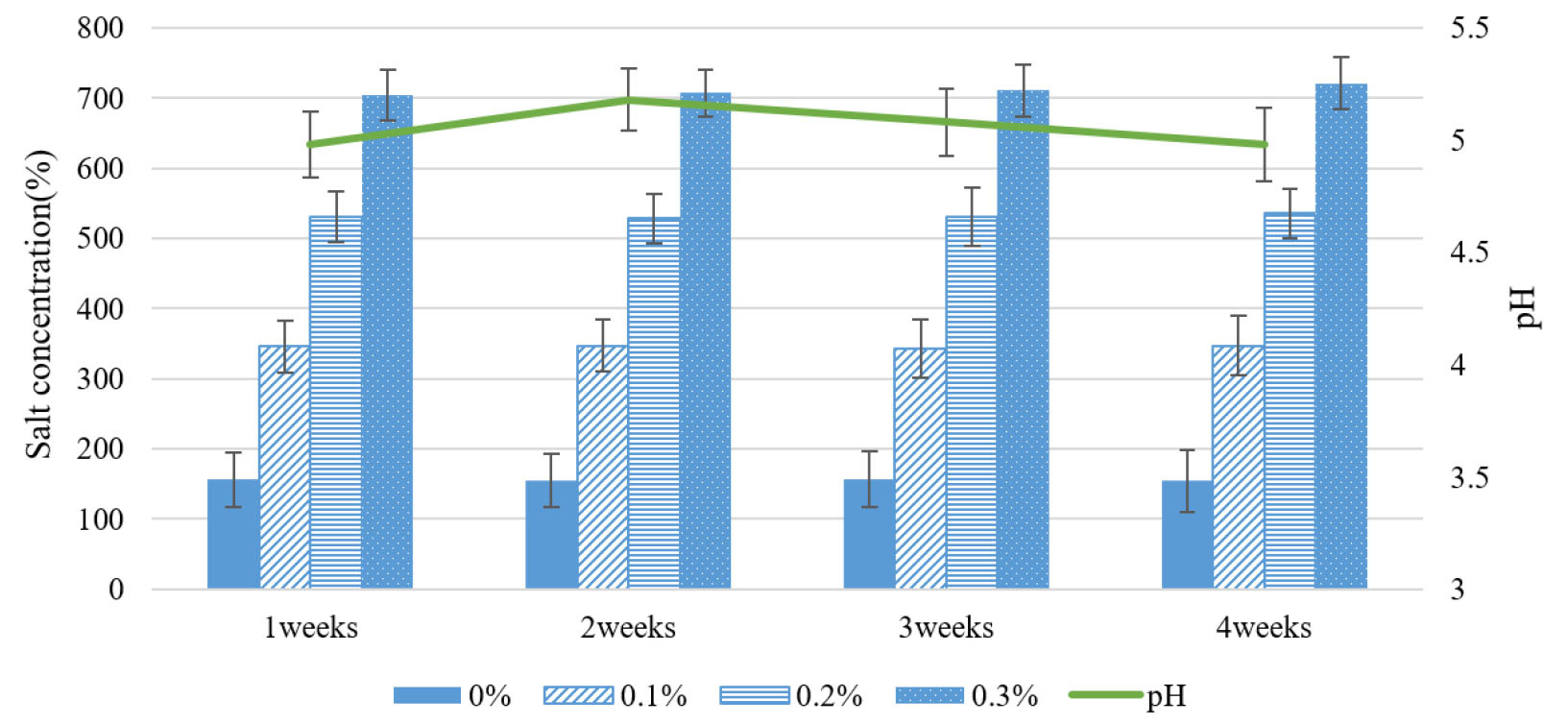
In hydroponic culture, the seedlings were planted to a styrofoam plate with 14 holes on nutrient solution in a 15 L circulation type hydroponic grower (45.0×30.5×21.0 cm). Hoagland solution was used as the hydroponic culture medium (Table 1). The pH of the medium was maintained at pH 5.07 ± 0.07 using citric acid buffer during the cultivation period. Four salt concentrations were treated using NaCl as 0%, 0.1%, 0.2%, and 0.3%, and four nitrogen concentrations were treated as 0 me/L (Nitrogen 0%), 12 me/L (Nitrogen 100%). 18 me/L (150% nitrogen), and 24 me/L (200% nitrogen). The culture medium adjusted for pH, salt concentration and nitrogen content was replaced at weekly intervals and cultivated for 4 weeks (Fig. 1). After cultivation, plant height, root length, primary tillering, mortality rate, fresh weight and dry weight were investigated. During the experiment, the average temperature of the greenhouse was 30.3°C, the average atmospheric humidity was 69.1%, and the average dew point was 22.9°C.
Table 1.
The composition of Hoagland solution.*
| Nutrient | Macronutrients (me/L) | Micronutrients (ppm) | |||||||||
| N | P | K | Ca | Mg | Fe | B | Mn | Zn | Cu | Mo | |
| Concentration | 12 | 3 | 6 | 7 | 4 | 2.0 | 0.5 | 0.5 | 0.05 | 0.02 | 0.01 |
Field experiment
The field experiment was carried out for two years from 2020 to 2021 at the reclaimed paddy field located in the Yeongsan river basin in Muan, where the salt concentration was 0.1~0.3%, and the drainage characteristics was classified to poorly drained paddy fields (NICS, 2013), The weather conditions during the experiment are shown in Table 2.
Seeds were sown on May 25 and transplanted after raising seedlings for 35 days in each year. The transplantation densities were 30 × 20 cm (15 hills/m2) and 30 × 10 cm (26 hills/m2) with two treatments. The nitrogen (N) application amount were 18 kg/10a, 27 kg/10a, and 36 kg/10a, where 18 kg/10a corresponded to the optimum N application amount in hydroponics (12 me/L) and the others were N 1.5 and 2 times of optimum amount, respectively, which were set in consideration to check the possibilities to increase productivity by overusing of N fertilizers. Calculation of the field N fertilization amount (for 10a) from the N concentration of the hydroponic nutrient solution was as follows: 7 kg/10a (amount of N in the liquid of paddy soil layer, 33,333 L/10a, at the same concentration as 12 me/L) × 3 (fertilization times) - 3 kg/10a (natural supply of irrigation water) = 18 kg/10a. The amount of phosphorus (P) and potassium (K) were fixed at 9 kg/10a and 11 kg/10a, respectively. Nitrogen application was divided by three times; 50% for basal dressing, 20% at beginning tillering stage, and 30% at panicle differentiation stage. Phosphorus was all applied as basal dressing, and potassium was applied by dividing 50-50% as basal and tillering application. The test plots were arranged in a three-repeat split-plot design with the planting density as the whole plot and the nitrogen amount as the split plot. Soil characteristics were investigated three times: before transplanting, tillering stage, and heading stage. Plant growth characteristics such as plant height, number of tillers, stem length, panicle length were measured. The rice was harvested at 30 days after heading, and fresh weight and dry weight yield were evaluated.
Table 2.
Meteorological data during the experiment of Muan reclaimed paddy field in the south region of Korea. The data was provided by the Korea Meteorological Administration.
Statistical analysis
For statistical analysis, SAS statistics (Ver. 9.4) was used, and a significance test among means was performed at the 5% significance level using Duncan’s multiple range test.
RESULTS AND DISCUSSION
Seedling growth response to salt and nitrogen concentrations in hydroponic culture
Growth characteristics of the seedling of forage rice, Yeongwoo, according to different salt and nitrogen concentrations are shown in Fig. 2. Changes in plant length and root length according to salinity and nitrogen concentration were very similar. When the salt concentration was 0%, the plant length and root length increased as the nitrogen concentration increased from 12 me/L to 24 me/L, but at a salt concentration of 0.1~0.3% range, the highest growth was observed at 12 me/L of nitrogen concentration, and the growth of forage rice had a tendency to decrease as the nitrogen concentration increased more than 12 me/L.
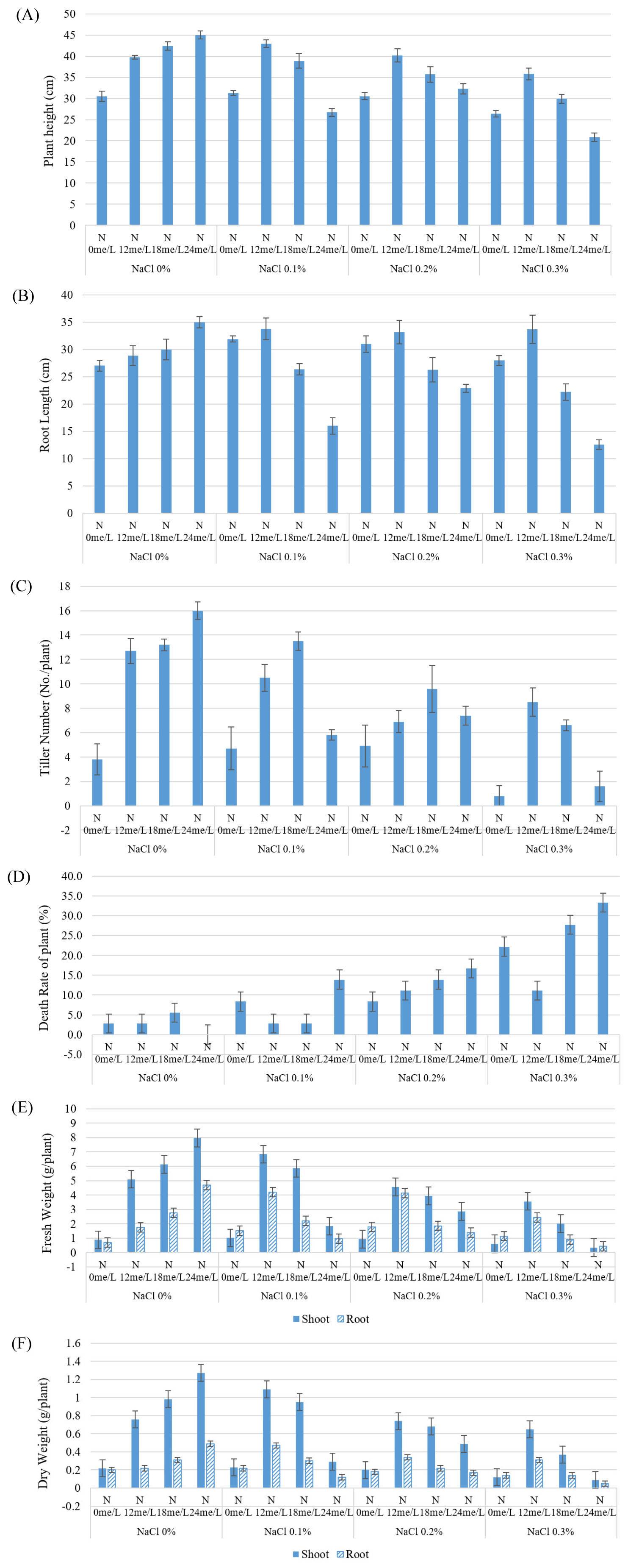
Looking at the change of tiller number responded to salt and nitrogen concentration, the tiller number increased as nitrogen concentration increased at 0% salt concentration, which was similar to the change of plant length and root length. However, when the salt concentration was 0.1% or 0.2%, the tiller number was the highest at 18 me/L of nitrogen concentration, and when the salt concentration was 0.3% it was the best at 12 me/L of nitrogen concentration.
The percentage of plant death rate during hydroponics increased significantly as the salt concentration increased. At 0% NaCl, the mortality was less than 5%, but it was about 3~13% at 0.1% NaCl, about 7~17% at 0.2% NaCl, and about 11~33% at 0.3% NaCl that the variation of mortality depends on the nitrogen concentration under the same salinity. Under the same salinity, the higher the nitrogen concentration of nutrient solution was, the higher the mortality of rice plant was.
The change of fresh weight and dry wight of plant according to salinity and nitrogen concentration were similar to those of plant and root length. At 0% NaCl, fresh weight and dry weight increased with increasing nitrogen concentration from 0 to 24 me/L, but at 0.1~0.3% range of NaCl, the highest weight was observed at 12 me/L of nitrogen concentration. In other words, in the nitrogen concentration range higher than 12 me/L, the plant weight (fresh or dry weight) had a tendency to decrease as the nitrogen concentration increased.
As shown in the above results, under salinity stress in hydroponic culture, the nitrogen concentration of 12 me/L greatly promoted growth of forage rice compared to non-nitrogen cultivation, but the nitrogen concentration higher than 12 me/L actually inhibited the growth.
Regarding the nitrogen supply under salinity stress, Sikder et al. (2020) reported that nitrogen can overcome salt-mediated damage to some extent by activating the antioxidant defense system and enhancing the accumulation of osmolytes such as soluble sugars, soluble proteins and free amino acids. On the other hand, Ashraf et al. (2018) reported that the main mechanisms of nitrogen metabolism under salinity stress are reduction of salt-induced water solubility and absorption, destruction of root membrane integrity, inhibition of nitrate absorption by Cl-, low nitrate loading in the root xylem, and alteration of nitrogen assimilation activity. In other words, under salinity stress, nitrogen demand is reduced due to reduced enzyme activities, reduced transpiration and reduced relative growth rate. In rice plant under salinity stress, most genes involved in NH4+ assimilation were down-regulated, and the NO3- content in plants was greatly reduced (Wang et al., 2012a; Wang et al., 2012b). That is, since the amount of NH4+ assimilation under saline stress is limited, if more nitrogen is absorbed into the plant, it is not rapidly converted into protein and maintains a high concentration, which may cause excessive disturbance (Sonneveld & Voogt, 2009). In addition, when NH4+ is excessive in the nutrient solution, it antagonizes other cations such as K+, Ca++, and Mg++ during the absorption process, reducing the absorption of these elements and causing various physiological disturbances (Bar-Tal et al., 2001). Therefore, it can be concluded that excessive nitrogen (NH4+) concentration under salt stress hinders the uptake of other cations outside the plant, and can act as a toxin due to restriction of assimilation within the plant.
Growth and forage yield of Yeongwoo rice according to nitrogen fertilization amount and planting densities in Muan reclaimed paddy field
As seen above, nitrogen concentration of 12 me/L was judged to be an appropriate concentration for forage rice growth at salt concentration of 0.1~0.3% in hydroponics experiment. Therefore, the nitrogen fertilization amount level corresponding to optimum concentration was actually applied to the Muan reclaimed paddy field for Yeongwoo forage rice cultivation during two years.
The soil characteristics of the experimental filed are shown in Table 3. Before, transplanting, the soil pH was 5.6, the organic content was 23.7 g/kg, the effective phosphoric acid was 26.3 mg/kg, the potassium was 0.1 cmol+/kg, the calcium was 4.6 cmol+/kg, the magnesium was 0.1 cmol+/kg, and the EC was 4.8 ds/m. After transplanting, pH, phosphoric acid and magnesium content of soil increased slightly, and EC decreased to 1.5~3.8, and there was no significant differences of the other soil properties according to cultivation stage.
Table 3.
Soil characteristics of the experimental paddy field according to rice growth stage in Muan reclaimed paddy field.
In Muan reclaimed paddy field, the heading stage of Yeongwoo rice was around September 23 in both experimental years (data not shown). The characteristics of the growth and yield of the forage rice according to planting density and nitrogen fertilization amount in the reclaimed paddy field are shown in Table 4. The results showed some annual variation, but the trends of data were very similar. Therefore, looking at the growth results from the 2020 year, the plant height was the highest when the nitrogen fertilization rate was 18/kg/10a at both planting densities, and it tended to decrease as the amount of fertilizer increased. The number of tillers per hill was 27.0 when the nitrogen fertilization amount was 18 kg/10a at the planting density of 15 hills/m2, and it decreased to 24.7 at 27 kg/10a and 22.0 at 36 kg/10a of nitrogen. At the planting density of 26 hills/m2, however, the number of tillers per hill was 19.6 at N 18 kg/10a, and there was no significant difference in the number of tillers even if the amount of fertilization increased. As described above, looking at the number of tillers per hill, it was higher at 15 hills/m2 than at 26 hills/m2 of planting density, but calculating the unit area of 10a, the tiller numbers per 10a was 405,000 at 15 hills/m2 and 509,600 at the density of 26 hills/m2. In other words, the number of tillers per unit area was secured much more in the high-density treatment.
Table 4.
Growth characteristics and forage yield of Yeongwoo rice cultivated in Muan reclaimed paddy field at 30 days after heading.
The culm length was 58 cm at N 18 kg/10a in 15 hills/m2 and 67 cm at N 18 kg/10 in 26 hills/m2, and it tended to decrease as the amount of fertilizer increased in both two plant densities. The panicle length was varied in the range of 22~24 cm, but there was no significant difference among the treatments.
The leaf color measured by the soil plant analysis development (SPAD) chlorophyll meter showed crop nitrogen status. As shown the SPAD values in the table, the higher the nitrogen fertilization, the higher the SPAD value, and the higher the planting density, the lower the SPAD value of rice leaves.
Regarding the forage yield of Yeongwoo rice, the dry weight in average between 2020 and 2021 year was 1,569 kg/10a at 18 kg/10a of nitrogen application, 1,444 kg/10a 27 kg/10a, and 1,186 kg/10a in the low planting densities of 15 hills/m2. In the high plant density of 26 hills/m2, the dry weight was 1,763 kg/10 at 18 kg/10a of nitrogen application, 1.535 kg/10a at 27 kg/10a, and 1,405 kg/10a at 36 kg/10a, where the highest yield was from the treatment of 18 kg/10a nitrogen application in 26 hills/m2.
One reason for this result is that the number of tillers per unit area in the densely treated group of 26 hills/m2 was significantly higher than that of the wide planting treated group at 15 hills/m2. In addition, excessive nitrogen fertilizer is thought to be caused by a decrease in the amount of photosynthesis of the plant community due to over growth, and the deterioration of the light receiving posture due to the occurrence of lodging. Considering that the reclaimed paddy field where the experiment was performed is low soil acidity and poor drainage, it is judged that excessive nitrogen fertilizer will bring many adverse results for growth and yield.
According to the research on the appropriate seeding amount when cultivating rice by direct seeding on flooded paddy surface in the west-southern reclaimed paddy field, the appropriate seeding amount was 5~7 kg/10a in 0.1% salinity paddy and 7~9 kg/10a in 0.3% salinity paddy, which means that reclaimed land should have 1.5 to 2 times of planting density higher than that of normal paddy fields (Back et al., 2006). Regarding cultivar characteristics on Yeongwoo rice, Ahn et al. (2018) reported that the cultivar had mid-late flowering and high dry matter yield with high feed value and multiple disease-insect resistance, and the yield was high when cultivated with a lot of nitrogen fertilizer (18 kg/10a) and densely planted (21~27 hills/m2 with 3~5 plants/hill). In addition, according to Choi (2013)’s research on the appropriate nitrogen fertilization amount for rice cultivation in newly reclaimed land, 16~18 kg/10a of nitrogen fertilization is suitable for securing stable rice yield with little salt damage.
As described above, when the results of this experiment and previous studies by other researchers are combined, we could conclude that the appropriate nitrogen application amount was 18 kg/ 10a for forage rice Yeongwoo cultivation in the reclaimed paddy field, and when the nitrogen concentration was higher than the optimal level under salt stress, the productivity of forage rice decreased more as the nitrogen concentration increased.