


In the era of twentieth century, people are attained their attention on preventive medicine and health, so healthy functional foods and natural functional materials from useful plants, which have various bioactive substances are growing bigger, therefore, cultivation and production of useful plants are being increased to secure such materials.
The Codonopsis lanceolata, which belongs to the Campanulaceae, is used for foods or medicine and is distributed mainly in Korea, Japan, and China. Especially the root of Codonopsis lanceolata contains useful materials, such as saponin, carbohydrate, vitamin B1, B2, and protein, thus it’s well known as Codonopsis lanceolata is effective to reduce blood pressure, cough, and fatigue. Although Codonopsis lanceolata is profitable, researches regarding its cultivation and contents are insufficient, compared to other major plants.
It’s well known as the plant type, type of root, color tone, and lateral root type of Codonopsis lanceolata are differentiated by their habitats (Lee et al., 1996). Kim (2003) reported that there is significant correlation found regarding factors such as number of leaves, stem length, and photosynthetic rate by its region. Moreover, not only the appearances, but also the active components, inorganic components (Lee et al., 1991), and aroma components (Kim et al., 1999; Lee et al., 1995; Oh et al., 2006) of the root are varied by their growing area, therefore, the planting area is being specified.
In this study, growth, yield, and inorganic components were compared and analyzed to understand the varied characteristics by Codonopsis lanceolata planting areas.
MATERIALS & METHODS
The roots (fresh weight 7.5~8.0 g) of biennial Codonopsis lanceolata were collected from Korea (Pyeongchang) and Japan (Nagano prefecture) in the autumn of 2013. The roots (100 units in each region) were planted in the experimental field of the Woosong Information College on April 27, 2014. As of appearing more than or equal to two foliage leaves, growth characteristics, such as plant height, leaf width, leaf length, and number of branches, were measured with an interval of 15 days. In the same year on October 25, those were harvested to measure plant height, leaf width, leaf length, number of branches, root length, root diameter, fresh weight, and so forth. Moreover, inorganic components for each part of Codonopsis lanceolata, such as leaf, stem, and root were also analyzed.
Analysis of inorganic components
The sample was incinerated at 600°C for 12 hours and then decomposed by wet combustion method (Woo and Ryoo, 1983) and then made its quantity fixed with deionized distilled water to test the liquid. After adding 10 ml of thick nitric acid to 2 g of the roots of Codonopsis lanceolata for each region, the solution was heated with low temperature at first and then gradually increase heating temperature to decompose it. Decomposed solution was chilled when the solution become white and transparent, and then added distilled water to the solution and made its quantity fixed to 100 ml, and then filtered it to make the remained liquid as the sample. The quantity of each mineral content was examined by ICP (Inductively Coupled Plasma, 3300 DV, Perkin Elmer Optima, USA). The condition of analysis was maintained in the following; plasma 15 l/min for the gas flow rate, 0.5 l/min for the auxiliary, 0.8 l/min for the nebulizer, 1,300 watts for the RF power, 1.0 ml/min for the flow rate, 18.48 rpm for the speed, 1.0 ml/min for the sample flow rate, 30sec for the sample flush time, 4.0 ml/min for the sample flush rate, and 30sec for the delay time (Jung et al., 2012).
RESULTS & DISCUSSION
Growth and yield of Codonopsis lanceolata in Korea and Japan
Comparison of aboveground parts’ growth of Korean and Japanese Codonopsis lanceolata was resulted in Table 1. The plant height of Japanese Codonopsis lanceolata was 373.6 cm, however, result convinced that that it has more vigorous growth than Korean one. In addition, there was also significant difference recognized, since Japanese Codonopsis lanceolata had a larger leaf width, leaf length, and leaf thickness of 6.1 cm, 3.5 cm, 0.49 mm respectively, than those of Korean Codonopsis lanceolata. However, the flowering day of Korean Codonopsis lanceolata was initiated from July 27, which is 2 weeks faster than the Japanese one. It was reported that there is no significant difference of leaves’ growth characteristics for each habitat of Korea (Kim et al., 1998). Growth of leaves in Nagano region, the mountainous area of Japan, was better than the Korean one. In addition, in this study, flowering day of Pyeongchang and Nagano, located in almost same latitude and having a similar annual average temperature, was differed about 14 days. This result is contrary to the report-flowering day of wild Codonopsis lanceolata tends to be earlier in central and northern region than that of southern region (Lee et al., 1996).
Table 1.
Comparison of growth characteristics in Korean and Japanese Codonopsis lanceolata
| Varietiesz | Plant heigth (cm) | Leaf | Leaf color (SPAD-501 value) | Stem diameter (mm) | Flowering day | ||
|---|---|---|---|---|---|---|---|
| length (cm) | width (cm) | thickness (mm) | |||||
| Korean | 338.7ay | 5.3a | 3.1a | 0.35a | 30.6a | 4.0a | July 27 |
| Japanese | 373.6b | 6.1b | 3.5b | 0.49b | 36.5b | 5.1b | Aug. 10 |
As for underground parts, there was no significance of the root length of Korean and Japanese Codonopsis lanceolata of 19.8 cm and 20.5 cm respectively, however, Korean Codonopsis lanceolata had a wider root diameter of 21.2 mm, so significance was recognized in that property. Total fresh weight of root was 41.0g and 39.0 g for Korean and Japanese respectively, thus no significance was found. However, considering fresh weight of each part of the root, Korean one had a more fresh weight of the main root part by 35.4 g, but Japanese one had a more fresh weight of the lateral root part by 9.6 g (Table 2). It was reported that the less soil moisture potential the more rootlet is found (Yoon and Lee, 2000), however, according to the results of this study, conducted by comparing Codonopsis lanceolata in same cultivating area, it was thought that the reason of varied growth for each part of the root was not for soil moisture, but the growth type for each region’s underground parts.
Inorganic components of Korean and Japanese Codonopsis lanceolata
The inorganic components of Codonopsis lanceolata for each part of Korean and Japanese Codonopsis lanceolata was shown in Table 3. Each inorganic component was found more in the aboveground parts, regardless of the region and the content of K was the largest. Regarding the content of macroelements for each part of Codonopsis lanceolata, the content of Na, Mg, P, S, and Ca in Korean Codonopsis lanceolata was found the highest on the leaf, followed by stem and root (Fig. 1). In the case of Japanese Codonopsis lanceolata, same result was found on the content of Mg and Ca, however, the highest content of Na and P was found in the stem. The highest content of K was found on the stem, followed by leaf and root for both of Korean and Japanese Codonopsis lanceolata. In terms of the content of macroelements for each region, the stem of Japanese Codonopsis lanceolata had a significantly higher content of Na, and the leaf of Korean Codonopsis lanceolata had much more Mg. The content of P was found higher in Korean one for the leaf part and in Japanese one for the stem and root part. There was no regional difference in the content of Ca. Concerning the content of microelements for each part, in the case of Co, it was highly found in the root for Korean Codonopsis lanceolata and in the leaf for Japanese Codonopsis lanceolata, and the largest content of other mineral elements was found in the leaf without regional differences. Examining the difference of the contents of microelements for each region, there was not much difference found in the case of Mn, however, for Ni, Cu, and Zn, Korean Codonopsis lanceolata had slightly more contents of them. In the case of Fe, Korean Codonopsis lanceolata had more contents for the leaf and root part, and Japanese Codonopsis lanceolata had more contents for the stem part. The mineral, Pb, nothing but the poisonous, was slightly contained in the leaf and stem part, however, not found in the root. As a result of this study, the contents of inorganic components of Korean and Japanese Codonopsis lanceolata were somewhat differed-it conforms to the prior study, which reported that the contents of mineral and metallic elements are varied by the plant’s part (Lee, 1992). Lee et al. (1996), reported that mineral contents of Codonopsis lanceolata, such as Mn, Zn, Na, and Cu, were not differed by its cultivating region, however, in this study, there were somewhat different contents found as opposed to such study.
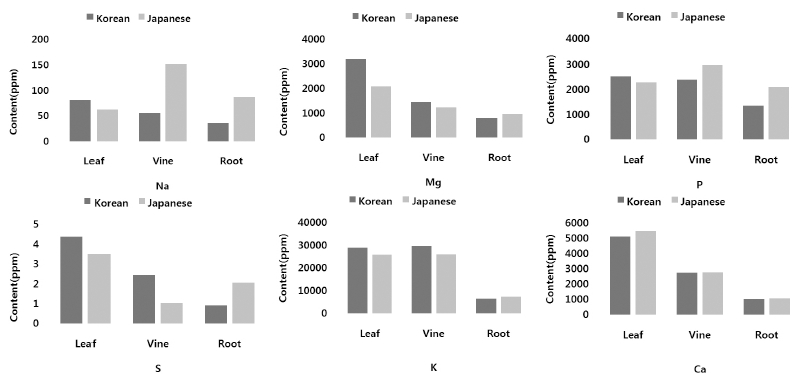
Fig. 1.
Comparison of Na, Mg, P, S, K and Ca contained in the various organs of Korean and Japanese Codonopsis lanceolata.Table 3.
Comparison of inorganic components contained in the Korean and Japanese Codonopsis lanceolata.