


Starch is stored as energy reserves in the sink tissues and is composed of two major components, amylose and amylopectin. Earlier studies established strong associations of starch structure with physical behavior and functionality in rice (Ito et al., 1989; Nakamura, 2002; Fujita et al., 2003). The variations in starch structure arise due to differential expression of various isoforms of starch biosynthetic enzymes. The varietal differences in the amylopectin structure exist predominantly due to chain length variation and play a critical role in determining physicochemical properties of starch in rice endosperm. Amylose content and gelatinization temperature are the two main measures to assess the rice grain quality. High temperature during the grain-filling stage causes deleterious effects on the yield and quality of crop products (Tetlow et al., 2004). Temperature above certain growthoptimal temperatures impairs dry matter production, generally decreasing grain size in all major cereal crops. Such small grains result in not only decreased yield but also low milling quality. Temperatures higher than 26°C render chalky grain appearance as well as reduction of grain weight in rice. Severely chalky brown rice grains are inferior for polishing quality and palatability. The chalky grains ripened under high temperature conditions resulted in lower yield after polishing and less sticky texture after cooking than translucent grains ripened under low temperature. It has been reported that high temperature at the milky stage of grain filling has the greatest influence on rice grain chalkiness (Zhang et al., 2011), and the panicle is the most sensitive organ to high temperature (Sato & Inaba, 1976). There are known to be varietal differences in grain chalkiness among rice cultivars when ripened under a given temperature. Harvesting dates are also important factors to be considered for an optimum rice harvest (Champagne et al., 2005). Therefore, the objectives of the present study were to investigate the change of pasting properties and amylopectin size distribution on three colored rice cultivars.
MATERIAL AND METHODS
The study was conducted to found the changes of pasting properties of starch in three colored rice cultivars with different harvest date at experimental fields of Gyeongsangbukdo Provincial Agricultural Research & Extension Services, Daegu, and Republic of Korea. The three colored rice cultivars, Hongjinju, Sintoheugmi, and Joseongheugchal, were transplanted on June 10. Planting distance was 30×15 cm, and fertilizer amount was N-P2O5-K2O = 9-4.5-5.7 kg/10a and fertilizer split application was basal-tillering stage-panicle initiation (50-25-25% ratio). In order to evaluate pasting properties of rice starch from each cultivar, rice grains were sampled 20, 30, 40, and 50 days after heading from transplanting time. 10 g of rice grain was placed with 10 stainless steel balls (16-mm diameter) in the mill (Fritsch, Type: 06.101, Germany). The particle size distribution of 0.02% sample suspended in analytical-grade ethyl alcohol was measured for 60 s by laser particle size analyzer (Malvern Mastersizer 3000). The median particle diameter (PS 50 in μm) was calculated using software provided by Fritsch Co. The volume-weighted size distribution was determined at D10 representing a cumulative 10% particle size. Gel properties of rice flours were determined by using a Rapid Visco Analyzer (RVA, Model 4, Newport Scientific, Sydney, Australia). Each rice sample (flour 3 g, 12% moisture basis) was mixed with 25 ml of deionized water in an RVA sample canister. The idle temperature was set at 50°C, and the following 12.5 min test profile was run: 50°C held for 1.0 min, the temperature was linearly ramped up to 95°C until 7.3 min, the temperature was linearly ramped down to 50°C at 11.1 min and held at 50°C until 12.5 min. The chain-length distribution of amylopectin was determined by HPAEC with pulsed amperometric detection (HPAEC-PAD) according to the method (Kasemsuwan et al., 1995) with modifications (Wang & Wang, 2000). The HPAEC system (Dionex DX500, Sunnyvale, CA) consisted of the following components: a GP50 gradient pump, an LC20-1 chromatography organizer, an ED40 electrochemical detector, a CarboPac PA-1 guard column, a CarboPac PA1 analytical column, and an AS40 automated sampler. The collected data were analyzed by using SAS package (version 8.0, SAS Institute Inc., Cary, NC) for LSD and Dunkan’s multiple range tests.
RESULTS AND DISCUSSION
Three cultivars of rice grain with varying heading time (early, intermediate, and late maturing) and different colored, two from each of three bran colors, black (Sintoheugmi, non-glutinous, and Josengheugchal, glutinous), and one from each of three bran colors, red (Hongjinju, non-glutinous) were used for the this study. Changes of mean air temperature and accumulative temperature as affected by different harvesting time in three colored rice cultivars were shown in Table 1. The recorded mean air temperatures were a little different from the first harvesting time to final harvesting time except for Josengheugchal rice cultivar. Difference in mean air temperature at both 20 and 50 day after harvesting time was greatest to 4.3°C in Josengheugchal rice cultivar.
Table 1
Differences in mean and cumulative temperatures related to different harvest times in three colored rice cultivars.
| Cultivars | Heading time (date) | Harvesting time (DAH♩) | Mean temp.† (°C) | Cumulative temp‡ (°C) |
|---|---|---|---|---|
| Hongjinju | Aug. 16 | 20 | 24.8 | 496 |
| 30 | 24.7 | 742 | ||
| 40 | 24.0 | 958 | ||
| 50 | 22.7 | 1,137 | ||
| Sintoheugmi | Aug. 7 | 20 | 25.6 | 512 |
| 30 | 25.8 | 774 | ||
| 40 | 25.6 | 1,023 | ||
| 50 | 24.6 | 1,231 | ||
| Josengheugchal | Aug. 28 | 20 | 25.6 | 512 |
| 30 | 23.8 | 714 | ||
| 40 | 22.2 | 887 | ||
| 50 | 21.3 | 1,063 | ||
The pasting properties of three colored rice flours obtained from different harvesting times after heading were characterized from Table 2. Seven major parameters of starch pasting properties, peak viscosity (PKV), hot pasting viscosity (HPV), cool pasting viscosity (CPV), setback (CPV minus PKV), breakdown (PKV minus HPV), peak time, and pasting time were determined by Rapid Visco Analyzer. The peak viscosity, hot viscosity, cool viscosity and peak time were influenced by different harvesting times. Pasting time was not changed with prolonged harvesting time in three colored rice cultivars. The colored and non-glutinous rice cultivars, Hongjinju and Sintoheugmi, was evidently had higher pasting temperature than the colored and glutinous rice cultivar, Josengheugchal. The Hongjinju rice cultivar exhibited the highest pasting temperature ranging from 90.9 to 92.3°C at varying harvesting times and Josengheugchal rice cultivar had the lowest pasting temperature ranging 76.1 to 76.8°C at varying harvesting times.
Table 2
Pasting properties of rice flour affected by different harvest times determined using a Rapid Visco Analyser in three colored rice cultivars.
| Cultivars | Harvesting date (DAHa) | Pasting time (min.) | Pasting temp. (°C) | Viscosity (cP) | ||||
|---|---|---|---|---|---|---|---|---|
| PKVb | HPV | CPV | BD | SB | ||||
| Hongjinju | 20 | 4.5 | 91.7a | 1,010 | 845c | 2,049 | 165c | 1,039d |
| 30 | 4.5 | 90.9a | 1,165 | 907b | 2,436 | 258d | 1,271c | |
| 40 | 4.6 | 92.3a | 824 | 830c | 2,298 | -6a | 1,474b | |
| 50 | 4.5 | 90.9a | 1,079 | 1,064a | 2,638 | 15b | 1,559a | |
| Sintoheugmi | 20 | 4.3 | 89.4b | 783 | 592c | 1,258 | 191b | 475d |
| 30 | 4.3 | 89.3b | 1,029 | 766b | 1,817 | 263c | 788c | |
| 40 | 4.3 | 89.5b | 1,509 | 1,292a | 2,678 | 217b | 1,169b | |
| 50 | 4.6 | 92.4a | 794 | 796b | 2,297 | -2a | 1,503a | |
| Josengheugchal | 20 | 3.2 | 76.1a | 470 | 381c | 536 | 89c | 66c |
| 30 | 3.3 | 76.7a | 407 | 393b | 563 | 14a | 156a | |
| 40 | 3.3 | 76.9a | 468 | 420a | 602 | 48b | 134b | |
| 50 | 3.3 | 76.8a | 386 | 376c | 534 | 10a | 148ab | |
Pasting temperature in each rice cultivar differed from each harvesting time, and pasting temperature of the two rice cultivars, Hongjinju and Joseongheugchal, showed the highest at the 40 days after heading and then it decreased at the final harvesting time. The lower pasting temperature in the Josengheugchal rice cultivar could possibly due to weaker resistant to loss of molecular arrangement on gelatinization procedure (Wanida et al., 2012). Pasting properties are influenced by amylose content, lipid content and amylopectin branch chain length distribution and also affected by diverse environmental factors such as mean air temperature, and harvesting time during grain development (Kim et al., 2016).
The peak viscosity value of two non-glutinous colored rice cultivars, Hongjinju and Sintoheugmi, was higher than that of the glutinous rice cultivar, Josengheugchal. Harvesting date at each colored rice cultivar did not significantly affect pasting time and cooling peak viscosity. Setback value in Hongjinju rice cultivar was significantly affected by harvesting date, with latest date (1,559 cP at 50 days after heading) being significantly higher than at earliest date (20 days after heading). It was reported that different harvesting dates had little influence on pasting properties (Lui et al., 2003). However, our results showed that pasting temperature, breakdown, and setback values were significantly affected by different harvesting dates in each colored rice cultivar. It was considered that change of pasting properties was much more affected by starch properties like a waxy and/or glutinous traits rather than pigment by itself at each colored rice cultivar in spite of no significant interactions.
Starch properties are mainly influenced by the cultivars and by diverse environmental factors (Noda et al., 2004). The representative profiles of the distributions of amylopectin unit-chain determined by HPAEC difference as affected by different harvesting times in three colored rice cultivars are presented in Fig. 1. It is well known that the distribution profile of the amylopectin unit-chain differs depending on plant sources, cultivars and diverse environmental factors (Noda et al., 2004; Umemoto et al., 1999).
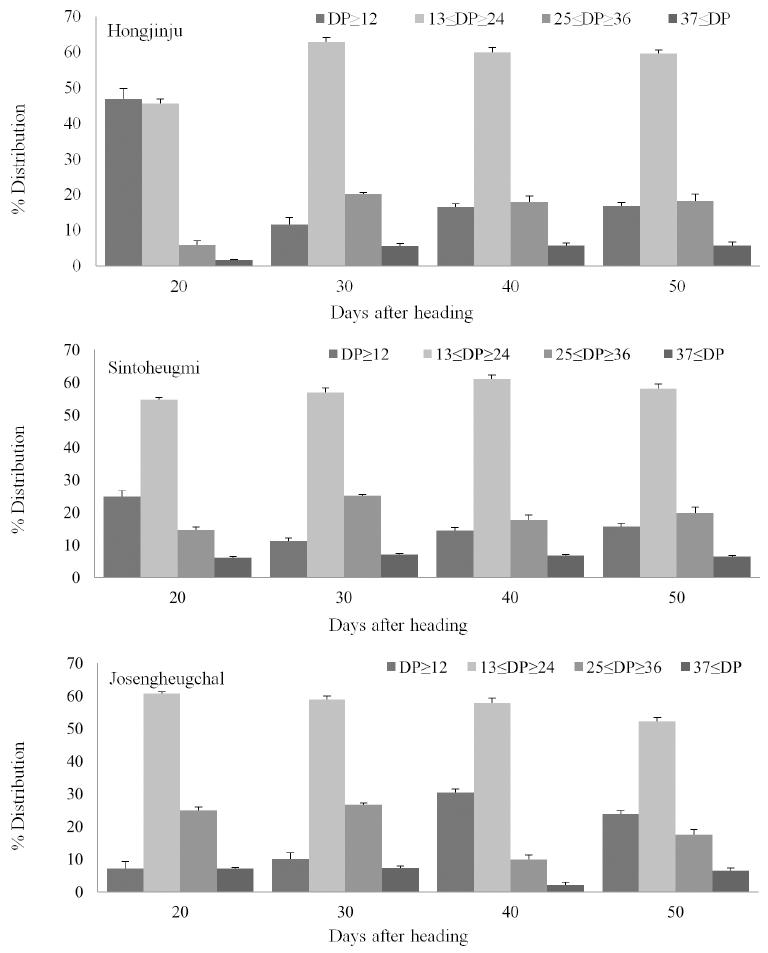
In changes of amylopectin branch chain-length distribution, a distinct difference was exhibited in the size distribution of amylopectin of three colored rice cultivars.
Distribution of amylopectin from Hongjinju rice cultivar at earlier harvesting time contained more very short chains with degree of polymerization (DP) between 6 and 12, and less chains with DP from 13 to 24 than that of later harvesting time (30, 40, and 50 DAH), while there is little increased difference in the distribution of longer chains with 25≤DP≥36, and 37≤DP among three different harvesting times compared to the earlier harvesting times. Non-glutinous colored rice cultivars, both Hongjinju and Sintoheugmi rice cultivars, had much higher amounts of A chain with DP≥ 12 compared to the that of glutinous colored rice cultivar, Josengheugchal. Altered mean air temperature commonly seemed to increase the amount of long B chains with 37≤ DP, and decrease that of short chains of amylopectin by in three colored rice cultivars. These results suggested that amylopectin structure affecting the varietal difference in patterns of chain length of amylopectin during grain filling and ripening were dissimilar to those causing the pigment effects on amylopectin fine structure in three colored rice cultivars. Change of mean granule size and scanning electron micrograph of rice starches for three colored rice cultivars as affected by different harvesting time were shown in Table 3 and Fig. 2, respectively. It is well known that mean size of starch granule were gradually enlarged with later harvesting time in all colored rice cultivars. Among granule size distribution of starches, the larger starch granule was observed in Josengheugchal rice cultivar and the smaller granule size of starch was also exhibited in Hongjinju rice cultivar.
Table 3
Change in mean granule size (μm) of starch in three colored rice cultivars with different harvest times.
| Cultivars | Days after heading | |||
|---|---|---|---|---|
| 20 | 30 | 40 | 50 | |
| Hongjinju | 4.64±0.41 | 4.82±0.22 | 4.91±0.13 | 4.90±0.12 |
| Sintoheugmi | 4.72±0.49 | 4.89±0.50 | 5.06±0.21 | 5.07±0.20 |
| Joseongheugchal | 4.91±0.23 | 5.14±0.33 | 5.13±0.19 | 5.15±0.15 |

In addition, later harvesting led to clear increase the mean granule size of starch in three colored rice cultivars. The present study revealed that the mean granule sizes of colored rice starches at later harvesting time were in the range of 4.78~5.02 μm, in Hongjinju rice cultivar, in the range of 4.87~5.27 μm, and in the range of 5.00~5.30 μm, respectively.
Current results shows that the granule size of starch increase with the increasing of potato tuber (Sugimoto et al., 1995). In addition, a positive correlation was also observed between the weight of tubers and the mean size of starch granules (Noda et al., 2004). The change of amylopectin side chain elongation was affected directly by not pigment but different harvesting time. Finally, further study is needed to better understanding for possible relation between pigment content and harvesting time.