


When the mother crop are cut and exposed to the appropriate environment, it develops new sprouts with characteristics almost equal to its original form and capacities. This technique is widely used in the production of many crops such as sugarcane, bananas and pineapples (Junelyn and Rosa, 2004). The main advantage of rice ratooning is that double crop of rice can be grown for additional returns. Rice ratooning is not a new practice with farmers in many other countries. It has been successfully adopted in India (Gupta and Mitra, 1948; Reddy et al., 1979), Japan (Nagai, 1958; Ishikawa, 1964), the United States (Beachell and Evatt, 1960), the Philippines (Parago, 1963), Brazil (Ramos and Dittrich, 1981), Swaziland (Evans, 1957), Thailand, Taiwan (Iso, 1954), China (Yang et al., 1958) and Ethiopia (Prashar, 1970). Further studies on the interactions among factors including rice cultivars, water, light and soil fertility greatly influence are required for better ratooning manipulation. A great deal of information is available on ratooning in rice (Chauhan et al., 1985; Nakano and Morita, 2007). The success of a good ratoon crop depends on the care with which the main crop is cultivated in the growing season. Agronomic practices and the care with which the main crops are protected against insect pests and diseases are a determining factor on how effective and efficient the ratooning will be (Rehman et al., 2007). Harvest time, cutting height, fertilizer application, irrigation management, plant protection and weed control for the main crop naturally have a great bearing on the growth and yield of the ratoon crop. This paper discussed the effect of the cultural factors that affect ratooning from rice stubble.
MATERIAL AND METHODS
The studies were conducted in the rice field of Gyeongsangbukdo Provincial Agricultural Research and Extension Services, Daegu, the Republic of Korea. The site is located at 128° 34'E, latitude 35° 58'N and 50 m from the sea level. The previous crop grown on the field was rice and this land has been used for rice cultivation over years. The annual rainfall and average temperature in Daegu are about 1,064 mm and 14.1°C respectively. The average daily temperatures during the cropping season for the year 2012 and 2013 were 20.6°C, 21.6°C. The amounts of rainfall during the cropping season for the year 2012 and 2013 were 967 mm and 830 mm. The field experiment was carried out from May to November of the year 2012 and 2013. Korean rice cultivar ‘Jinbuol’ was used to evaluate the profitability for ratooning. And their ratooning response was estimated depending on various cultural practices. Sowing dates were April 15. The seedlings were transplanted 30 days after seeding at a spacing of 30 cm between rows and 15 cm between hills using 2~3 seedlings per a hill in a split plot design with 3 replications. The main crop was fertilized with 90 kg/ha N, 45 kg/ha P2O5, and 57 kg/ha K2O. The plots were weeded regularly, to minimize weed infestation. The grain was dried to a moisture content of 15% and weighed. Whole crop dry matter was weighed after drying at 60°C for a week.
Stubble height
The main crop was harvested at mass maturity, after which the tillers were hand-mowed to stubbles with 10, 20, 30 and 40 cm height. These were then left without any further input, until the ratooned plants were ready for harvest. The heading of panicle was counted with an interval of week. The yield components, milled rice quality and boiled rice palatability of the ratoon rice derived from stubble were checked.
Water management
Soon after the first harvest, the tillers were hand-mowed to stubble of about 10 cm height. They were then left with or without irrigation, until the ratooned plants were ready for harvest. The harvested stubbles were managed with sufficient soil moisture to the end of tillering, and then plots were flooded to 15 cm until grain maturity initiation of the ratoon crop. Records were kept to compare the panicle length, grain setting, grain yield and milled rice quality in the ratoon crops by irrigation. The grains from both harvests were dried to the moisture of 15% and subsequently weighed.
Fertilizer management
For the estimation of fertilizing effects on ratoon rice production, the ratoon crop was managed with and without 30 kg/ha of N soon after the main crop harvest. The yield components, milled rice quality and boiled rice palatability of the ratoon rice grown under the different fertile conditions were checked.
The milled rice quality and boiled rice palatability test
For component analysis, milled rice sample was used. The grains were milled by putting on pressure uniformly to 92% milled rice per brown rice ratio. Amylose and protein contents of milled rice were determined using Near-Infrared Grain Tester (FOSS, Australia). TOYO-Tester (MA90B, TOYO, Japan) was used for measuring of TOYO-value. Cooking qualities were the evaluated by using the Rice Taste Analyzer (SATAKE, Japan). Differences between treatments were evaluated for significance by the Duncan's multiple range test (DMRT) at 5%.
RESULTS AND DISCUSSION
Rice ratooning from different stubble height
Ratooning is caused by the development of the axillary buds at the nodes of the stubbles left after the harvest. The objectives of this study were to evaluate the effects of main crop stubble height on ratoon grain yield and panicle growth parameters (Fig. 1, 2 and Table 1). Main crop, ‘Jinbuol’ rice cultivar, was harvested to leave 40, 30, 20, 10 cm stubble height. The highest ratoon yield, 2,810 kg/ha about 45% of the main crop yield, was obtained with the main crop harvested left 10 cm of stubble height (Table 1). The results from this study indicated that when the initial stubble height was increased from 10 to 40 cm, the growth of the crop was altered by shifting panicle point of origin and delaying grain ripening. Head rice ratio of ratoon rice was increased with the lower stubble height by 10, 20 cm. The protein and amylose content of milled rice of ratooned plant were not affected. The taste value of cooked ratoon rice was also not affected by different stubble cutting height (Table 2). The tillers might emerge from all nodes of the stubbles or from only the lower nodes or from any specific node number. Many findings suggested that the yield of ratoon crop might be increased when the main crop stubble is cut with 2-3 nodes left (Sanni et al., 2009). Ratoon crop growth duration was influenced by cutting height. Higher cutting height caused increase in growth duration (Bahar and Datta, 1977). Ishikawa (1964) and Quddus (1981) reported that cutting height of the main crop did not affect on the ratoon crop yield. Parago (1963) and Prashar (1970) suggested that the main crop should be cut close to ground level. Bahar and Datta (1977), however, reported that cutting at ground level produced lower ratoon yields than did higher cutting. Because of the genetic variability among cultivars, there was scope to fix the cutting height to realize the optimum yield specific to cultivar and site, rather than to depend on general findings (Shamiulislam et at., 2008).
Table 1.
Ratoon rice yield components at different cutting heights of main stubble in 'Jinbuol' rice cultivar.
| Stubble height (cm) | Panicle length (cm) | Spikelets per panicle | Ripened grain (%) | 1,000 brown rice weight (g) | Grain yield (kg ha -1 ) |
|---|---|---|---|---|---|
| 10 | 13 ns† | 25 ns | 72.7 a | 26.1 a | 2,810 a |
| 20 | 13 | 20 | 60.4 b | 26.1 a | 2,110 b |
| 30 | 13 | 21 | 55.9 b | 24.7 b | 1,990 bc |
| 40 | 12 | 23 | 69.3 ab | 24.6 b | 2,240 b |

Fig. 1.
Growing phase of the ratoon rice at different stubble height (upper) and new shoots emerging point of main stubble (under). The photo was taken at six weeks after main crop harvest.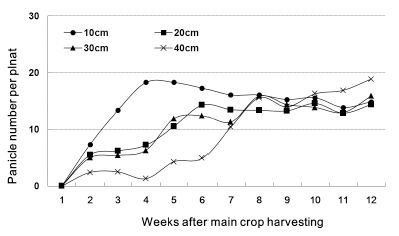
Fig. 2.
Heading response of ratoon rice at different stubble heights of main crop in ‘Jinbuol’ rice cultivar.Table 2.
The milled rice quality and boiled rice palatability of the ratoon rice at different cutting heights of main stubble in ‘Jinbuol’ rice cultivar.
| Stubble height (cm) | Protein (%) | Amylose (%) | Head rice (%) | TOYO value | Cooking quality |
|---|---|---|---|---|---|
| 10 | 8.6 ns† | 19.0 ns | 63.6 ab | 72 ns | 60 ns |
| 20 | 8.7 | 19.6 | 70.1 a | 73 | 61 |
| 30 | 8.6 | 19.9 | 59.7 b | 74 | 61 |
| 40 | 8.2 | 19.6 | 20.4 d | 75 | 57 |
Effect of irrigation on ratoon rice production
Irrigation on stubbles after main crop harvest did not affect the ratoon crop yield and ratoon rice quality. There were no significant difference in estimated characters between managed plot with water and non-irrigated plot (Table 3, 4). Bahar and Datta (1977) noted that the irrigating fields immediately after harvest might cause the stubbles to rot, especially where plants were cut close to the ground, resulting in missing hills. Studies suggested that fields should not be flooded until the new ratoon tillers reached to 10~15 cm high. However, Mengel and Wilson (1981), in their studies on the effect of irrigation requirement on the grain yield and milling quality of the ratoon crop of some cultivars, observed that shallow irrigation given as continuous flooding immediately after main crop harvest gave better grain yields and plant characters than short term delayed flooding
Table 3.
The change of yield components of ratoon rice by irrigation on stubbles of main crop in ‘Jinbuol’ rice cultivar.
| Treatment | Panicles per plant | Panicle length (cm) | Spikelets per panicle | Ripened grain (%) | 1,000 brown rice weight (g) | Grain yield (kg ha -1 ) | Whole crop dry matters (kg ha -1 ) |
|---|---|---|---|---|---|---|---|
| Non-irrigated | 14 ns† | 12 ns | 20 ns | 48.2 ns | 23.4 ns | 1,280 ns | 3,020 ns |
| Irrigated | 13 | 12 | 21 | 46.2 | 24.1 | 1,270 | 3,310 |
Table 4.
The change of milled rice quality and boiled rice palatability of ratoon rice by irrigation on stubbles of main crop in ‘Jinbuol’ rice cultivar.
| Treatment | Protein (%) | Amylose (%) | TOYO value | Cooking quality |
|---|---|---|---|---|
| Non-irrigated | 7.4 ns† | 20.0 ns | 72 ns | 60 ns |
| Irrigated | 7.7 | 18.9 | 70 | 60 |
Effect of fertilizer application on ratoon production
For early promote abundant rationing, which increases grain yield, it is important to apply fertilizer immediately after main crop harvest (Table 5). In the ratoon crop, the grain yield and straw yield was increased with N fertilizer dose on stubbles after main crop harvest, whereas decreased grain yield and straw yield was achieved from the plot with no application. Top dressing with 30 kg/ha of N fertilizer after main crop cutting gave the highest ratoon yield (Fig. 3). There was no significant difference in milled rice and cooked rice characters between managed plot with and without N fertilizer (Table 6). Ganguli and Ralwani (1954), in their experiments on N requirements of ratoon rice, noted little difference in ratoon yields between plots fertilized with 22 kg/ha of N and those fertilized with 44 kg/ha of N. However, the ratoon yield was decrease in the ratoon plots without N fertilizaton.
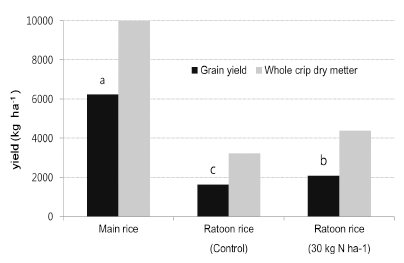
Fig. 3.
The change of grain yield and crop matters of ratoon rice by N fertilizer topdressing on stubbles of main crop in ‘Jinbuol’ rice cultivar.† The same letters in the table indicate no difference at 0.05 significance level.
Table 5.
The change of yield components of ratoon rice by N fertilizer topdressing on stubbles of main crop in ‘Jinbuol’ rice cultivar.
| N Treatment (30 kg ha -1 ) | Panicles per plant | Panicle length (cm) | Spikelets per panicle | Ripened grain (%) | 1,000 brown rice weight (g) | |
|---|---|---|---|---|---|---|
| Main rice | 20 a† | 19 a | 66 a | 86.3 a | 25.5 a | |
| Ratoon rice | control | 15 b | 12 b | 22 b | 43.8 c | 23.1 b |
| Topdressing | 19 a | 13 b | 26 b | 58.3 b | 24.2 ab | |
Table 6.
The change of milled rice quality and boiled rice palatability of main and ratoon rice by N fertilizer topdressing on stubbles of main crop in ‘Jinbuol’ rice cultivar.
| N Treatment (30 kg ha -1 ) | Protein (%) | Amylose (%) | TOYO value | Cooking quality | |
|---|---|---|---|---|---|
| Main rice | 7.3 ns† | 14.3 b | 62 b | 68 a | |
| Ratoon rice | control | 7.6 | 19.3 a | 70 a | 60 b |
| Topdressing | 7.8 | 19.8 a | 72 a | 57 b | |
Farmers would spend less in ratooning because they do not need either tilling the land and buying seed and herbicides. Ratooning might helps increase farm productivity per unit area per unit time. This is because a ratooned crop has shorter duration (Chauhan et al., 1985), and it almost costs less than growing a new crop. Moreover, it might minimizes the risk of pest and diseases and unpredictable bad weather conditions because of the shorter duration from the time new rice shoots appear until they are harvested. It also could maintain the genetic purity of the variety and requires less irrigation water.