


Alternative environment-friendly growth enhancers for rice are being promoted among rice farmers worldwide in order to reverse the negative impact of intensive chemical-based and conventional rice farming on yield sustainability and associated environmental problems. In agricultural productions systems, problems on environmental pollution associated with excessive use of agrochemicals have been reported that reduced the productivity of agricultural lands. Similarly, proper disposal of organic agricultural wastes are also a common concern among farmers for it is considered as an additional burden in the production system. These scenarios have prompted studies on developing technologies that will reduce these problems. For example, in wood industry, excessive production of sawdust has resulted to ingenious conversion of this wood waste material to charcoal. In the process of charcoal making, the emission of large amount of gas to the atmosphere is avoided by trapping the gas to make a condensate called pyroligneous acid or smoke vinegar. Moreover, organic by-products of agricultural produce that would just otherwise be wasted are now effectively recycled and used in agricultural productivity. Field and laboratory experiments showed that application of pyroligneous acid increased the root dry weight, promoted plant height, increased ear number and grain yield of rice (Tsuzuki et al., 2004). Similarly, the application of wood vinegar in rice revealed that when seeds and leaf were treated with the solution of wood vinegar in seedling stage and other growth stage no obvious effect on budding rate and the characteristics of seedling was seen, but the certain yield-increasing effect was produced (Jianming, 2003). And when the solution of wood vinegar was applied as a mixture with nitrogen fertilizer, the promotion of N-utilization efficiency was increased (Jianming, 2003)
Several rhizosphere bacteria provide benefits to the plant either form symbiotic relationships with the plant or are free-living in the soil. Example of different bacterial species and strains belonging that are known to enhance plant growth include those in the genera Azotobacter, Azospirillum, Pseudomonas, Acetobacter, Herbaspirillum, Burkholderia, Bacillus and Rhizobium (Gutiérrez‐ Mañero et al., 2001). Plant-growth promotion by these bacteria appears to be due to the release of factors that either prevent the deleterious effects of pathogenic organisms or facilitate nutrient uptake from the environment. Others affect plant growth through the production and release of plant hormones, such as auxins and gibberellins. Some of them had demonstrated beneficial influence on growth, yield and grain quality of rice (Biswas et al., Tsuzuki et al., 2000; 2000; Vessey, 2003; Hayat et al., 2010). For example, bacterial isolates have induced the production of indole acetic acid (IAA), solubilize phosphorus and consequently increase in plant height, root length, and dry matter production of shoot and root of rice seedlings (Ashrafuzzaman et al., 2009). Some of the bacterial isolates also increased seed germination of rice and increased dry matter production, plant height and root length of rice. In another study by Biswas et al. (2000), growth-promoting diazotrophs such as rhizobia can enhance the growth and development of associated crops by transferring fixed N or by improving nutrient uptake through modulation of hormone-linked phenomena in inoculated plants. Seeds and seedlings of rice Pankaj were inoculated with different rhizobia and grown in potted soil supplemented with varied amounts of mineral N showed increased rice grain and straw yields by 8 to 22 and 4 to 19%, respectively, at different N rates. Nitrogen, P, and K uptake were increased by 10 to 28% due to rhizobial inoculation. Nitrogen-15-based studies indicated that the increased N uptake was not due to biological N2 fixation (BNF). In addition, inoculation also increased Fe uptake in rice, enhanced the production of indole-3-acetic acid (IAA) and promote rice growth and yield.
Inevitably, applications of PA and plant growth promoting microorganisms have improved plant growth in several mechanisms. However, most of the previous study had evaluated the effect of microorganisms inoculation and PA on paddy rice singly, and no reports had evaluated the combine effect of microorganisms and PA on growth of rice. Therefore, in this study, the potential effect of combined application of different plant growth promoting microorganisms and PA on the growth and yield of paddy rice and on some soil chemical properties were determined.
MATERIALS AND METHODS
Experimental design and treatment description
The experiment was conducted at the Kyungpook National University Experimental Station, Daegu City, South Korea. The experimental design is a four factorial pot experiment that evaluated the effects of the inoculation of microorganisms and PA in combination with fertilizers and on different soil types. There are two types of soil (100% paddy soil and mixture of paddy soils + sand, 1:1); 3 levels of chemical fertilization: 0, 50% recommended rate (RR) and 100% RR; 3 types of microorganisms namely: Bacillus licheniformis, Fusarium fujikuroi and Rhizobium phaseoli; 3 levels of pyroligneous acids (wood vinegar, WV) 0 rate, 500 x dilution and 1000 x dilution applied at the rate of 4 liters per pot. There were 54 treatments combination including the control and replicated 3 times under complete randomized design.
Plant establishment and treatment application
Paddy soil used in the experiment was collected from the Kyungpook National University Experimental Station, Daegu City, Korea. Top soils within 0-25 cm depth were used and combined with washed river sand from local supplier. The soil and sand samples were air dried and sieved to pass through 0.5 cm mesh aperture before use. Half of the 162 pots were filled with paddy soil and the other half (81 pots) were filled with soil + sand mixture (1:1 w/w) at 12 kg/pot using a 23-cm diameter garden pots. Prior to transplanting, the soil was submerged for 2 weeks coinciding with the pre-germination and sowing of rice seedlings. When the seedlings were 16 days old, these were transplanted into the pot at the rate of 1 seedling per pot. The chemical fertilizers were applied at the rate of 90-55-48, kg N-P2O5-K2O ha-1 for full recommended rate. The Nitrogen (50%), phosphate (70%) and potash (100%) requirements were applied basally, using Urea – N, Rock Phosphate - P2O5, and Muriate of Potash - K2O while the rest of N and K were supplied 45 days after transplanting. For the 50% RR treatments, all the fertilizers were applied basally.
Pure culture of Bacillus licheniformis, Fusarium fujikuroi and Rhizobium phaseoli were obtained from RDA. The microorganisms were grow in liquid media with composition presented in Table 1 for 5 days or until such time that the microbial population density is about 10 8 cells forming units. These microbial cultures were directly inoculated on the roots of plants prior to transplanting at the rate of 10 ml per plant.
Table 1.
Growth media composition for the liquid culture of different microorganisms used in the experiment.
Wood vinegar was obtained from the Korean Ministry of Agriculture and Forestry. The pyroligneous acid was prepared from a liquid condensate extracted between 80 to 120 °C during the carbonization process (charcoal making) of Korean oak tree (Quercus sp.). The condensate was aged for 3 months and the thick liquid was collected. The same process was repeated before the commercial quality wood vinegar was collected. For treatments receiving wood vinegar, depending on the rate of application, wood vinegar was diluted with tap water into 500x and 1000 x dilution and added at 4 L per pot. Plants were maintained in 3cm-submerged condition with tap water until harvesting.
Measurement of growth characteristics and yield components
Growth characters (plants height, tiller number, and chlorophyll content), yield components (panicle number, panicle length, spikelets per panicle, ripening ratio, and 1000-grain weight), and yield were measured. Growth characters were measured at heading stage. The chlorophyll content was determined using a chlorophyll meter (SPAD-502, Minolta, Ramsey, NJ, USA) in the mid portion of the last well developed leaf. Ten plants per replicate were used for each parameter measured.
Soil Analysis
Two hundred grams soil samples collected after the experiment were air dried, sieved to pass through 2 mm, devoid of any roots and stored in -20℃ prior to analysis. Total C and N in soils were analyzed using a CHNS-elemental analyzer (FlashEA 1112 Series, Thermo Electron Corp., Rodano, Italy). Samples were powdered and analyzed in five replicates. The available N was analyzed by 1N KCl extraction followed kjeldahl steam distillation in a close system. The exchangeable bases was determined by extracting ten grams of soil sample with 1 N ammonium acetate at 1:5 soil-extractant ratio for 1 h under rotary shaker and filtered. Concentration of K, Ca, Mg, and Na were determined by ICP. Available P was determined based on Bray P2 extraction and the extract was analyzed using ICP spectrophotometer. Duplicate analysis for each sample was done to insure accuracy. All analysis was based on standard procedures outline in Page (1982).
RESULTS
Growth Characteristics and Yield Components
The results of the analysis of variance of different growth characteristics and yield component parameters were presented in Table 2. The effects of different factors considered were varied between plant parameters. Overall results showed that there was no significant interaction effect between soil x PGPR x Fertilizer x PA; PGPR x Fertilizer x PA and soil x PGPR x PA in all growth and yield parameters of rice.
Table 2.
The P values generated from 4-way analysis of variance of different plant growth and yield parameters of rice as affected by different types of soil, fertilization, microorganisms inoculation and wood vinegar application.
| Independent Variables | Plant Height | Number of Tillers | Chlorophyll | Number of panicle | Number of Grains | Weight of 100 seeds | Seed Filling Rate | Yield |
|---|---|---|---|---|---|---|---|---|
| soil | 0.171 | 0.081 | 0.233 | 0.054 | 0.004 | 0.000 | 0.157 | 0.000 |
| PGPR | 0.592 | 0.353 | 0.014 | 0.862 | 0.232 | 0.354 | 0.784 | 0.909 |
| Fertilizer | 0.000** | 0.000** | 0.000** | 0.000** | 0.000** | 0.047* | 0.005** | 0.000** |
| PA | 0.546 | 0.101 | 0.548 | 0.086 | 0.833 | 0.230 | 0.960 | 0.172 |
| soil * PGPR | 0.028* | 0.242 | 0.549 | 0.421 | 0.632 | 0.888 | 0.078 | 0.084 |
| soil * Fertilizer | 0.120 | 0.000** | 0.212 | 0.195 | 0.166 | 0.000** | 0.000** | 0.004** |
| soil * PA | 0.249 | 0.660 | 0.313 | 0.029* | 0.270 | 0.230 | 0.392 | 0.790 |
| PGPR * Fertilizer | 0.046* | 0.605 | 0.038* | 0.253 | 0.804 | 0.752 | 0.196 | 0.385 |
| PGPR * PA | 0.433 | 0.489 | 0.057 | 0.116 | 0.092 | 0.381 | 0.208 | 0.199 |
| Fertilizer * PA | 0.909 | 0.418 | 0.709 | 0.925 | 0.916 | 0.138 | 0.362 | 0.967 |
| soil * PGPR * Fertilizer | 0.034 | 0.726 | 0.443 | 0.283 | 0.973 | 0.150 | 0.229 | |
| soil * PGPR * PA | 0.860 | 0.523 | 0.630 | 0.544 | 0.244 | 0.278 | 0.520 | 0.311 |
| soil * Fertilizer * PA | 0.501 | 0.509 | 0.798 | 0.057 | 0.482 | 0.063 | 0.433 | 0.120 |
| PGPR * Fertilizer * PA | 0.661 | 0.333 | 0.562 | 0.659 | 0.799 | 0.266 | 0.605 | 0.726 |
| soil * PGPR * Fertilizer * PA | 0.825 | 0.860 | 0.288 | 0.940 | 0.991 | 0.123 | 0.120 | 0.535 |
Plant height
Plant height at the end of experiment was significantly affected by fertilizer application alone, and by the interaction effect of soil x PGPR and soil x PGPR x fertilizer (Table 2). Fig. 1 shows the main effects of different factors considered in the experiments and regardless of soil type, microorganisms inoculation and wood vinegar application, plants fertilized with full RR were taller compared to other rates. Increasing the fertilization rate from 0 RR to 50% RR also resulted to significant increase in plant height. Fig. 2 on the other hand showed the interaction effect of soil x PGPR x fertilizer. Generally, plant height increases with increasing amount of chemical fertilizer, however, inoculation of Bacillus licheniformis with 50% RR of chemical fertilizer in pure paddy soil resulted to significantly taller plants compared to those plants inoculated with other microorganisms receiving full RR chemical fertilizer. On the other hand, inoculation with Rhizobium phaseoli alone in paddy soil-sand mixture resulted to increased plant height comparable to those receiving 50% RR across different soil and fertilizer treatments.


Number of tillers
The number of tillers during the maximum tillering stage was significantly affected by the main effect of fertilizer and the interaction effect of soil x fertilizer (Table 2). Fig. 3 shows the main effects of different factors considered in the experiments and regardless of soil type, microorganisms inoculation and wood vinegar application, plants fertilized with full RR have more tillers compared to other rates. Increasing the fertilization rate from 0 RR to 50% RR also resulted to significant increase in the number of tillers. Fig. 4 on the other hand showed the interaction effect of soil x fertilizer. Fertilizer application at 50% RR and 100% RR were significantly different with each other in terms of tiller count regardless of soil type. However, in zero fertilizer treatment, plants from pure paddy soils have more tillers compare to those plants from paddy-sand mixtures.


Chlorophyll
The chlorophyll content as determined by SPAD value during the heading stage was significantly affected by PGPR, fertilizer ant its interaction and the interaction of soil x PGPR x fertilizer (Table 2). Fig. 5 shows the main effects of different factors considered in the experiments and regardless of soil type, microorganisms inoculation and wood vinegar application, plants fertilized with full RR had higher chlorophyll content compared to plants supplied with lower rates of fertilizer. Increasing the fertilization rate from 0 RR to 50% RR also resulted to significant increase of SPAD value. Fig. 6 on the other hand showed the interaction effect of soil x PGPR x fertilizer. In pure paddy soils, inoculation with Fusarium fujikoroi and Rhizobium phaseoli combined with 50% RR fertilizer resulted to comparable chlorophyll content with that of 100% RR + microorganisms inoculation. On the other hand, in paddy soil – sand mixture, inoculation of the 3 types of microorganisms combined with 50% RR fertilizer resulted to chlorophyll value comparable to the 100% RR + microbial inoculation.


Yield components
The panicle number was significantly affected by fertilizer and interaction effect of soil and wood vinegar. Fig. 7 shows the main effects of different factors considered in the experiments and regardless of soil type, microorganisms inoculation and wood vinegar application, plants fertilized with full RR had higher panicle number compared to plants supplied with lower rates of fertilizer. Increasing the fertilization rate from 0 RR to 50% RR also resulted to significant higher panicle than others.

Fig. 7.
Main effects of soil, fertilizer, microorganism inoculation and wood vinegar application on the number of panicles of rice. The same letters indicate no significant differences between treatments.In pure paddy soils, regardless of microbial inoculation and wood vinegar application, there was no significant differences in terms of panicle number among plants supplied with increasing amount of fertilizer while in paddy + sand mixture, those plants without chemical fertilizer or supplied at lower rate (50% RR) had significantly higher number of panicles compared to all other treatments (Fig. 8).
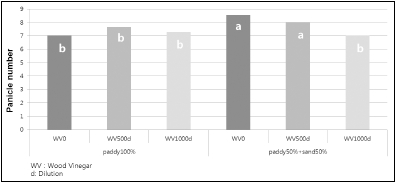
Fig. 8.
Interaction effects of soil x microorganisms x fertilizer application on the number of panilces of rice. The same letters indicate no significant differences between treatments.The number of spikelet per panicle was affected by soil type and fertilizer alone (Table 2). Plants grown in paddy+sand mixture had significantly higher number of spikelet compared to those plants grown in pure paddy soil regardless of microorganism inoculation, fertilization and wood vinegar application (Fig. 9). On the other hand, increasing the amount of fertilizer from zero to 100% RR significantly increased the number of spikelet per panicle regardless if soil type, microorganisms inoculation and wood vinegar application (Fig. 9).
The weight of 100 seeds and yield were significantly affected by soil and the interaction of soil x fertilizer (Table 2). Fig. 10

Fig. 9.
Main effects of soil, fertilizer, microorganism inoculation and wood vinegar application on the number of spikelets per panicles of rice. The same letters indicate no significant differences between treatments.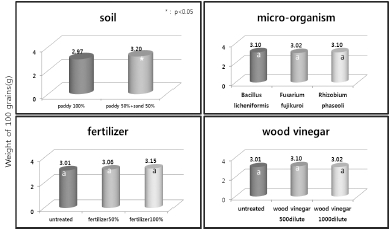
Fig. 10.
Main effects of soil, fertilizer, microorganism inoculation and wood vinegar application on the weight of 100 grains of rice. The same letters indicate no significant differences between treatments.showed that plants in paddy soil + sand had heavier weights of 100 grains compared to those plants grown in pure paddy soil regardless of microorganisms inoculation, fertilization and wood vinegar application. On the other hand, the interaction effect of soil and fertilizer revealed that plants from paddy soil+sand mixture and fertilized with 50% and 100% RR had heavier 100 grain weights compared to other treatment combinations regardless of the microbial inoculation and wood vinegar application (Fig. 11). The same analysis showed that 50% RR in pure paddy soil had the lowest 100 grain weight.

Fig. 11.
Interaction effects of soil x fertilizer application on the number of weight of 100 seeds of rice. The same letters indicate no significant differences between treatments.The seed filling rate was affected by the fertilizer application only (main effects) and not by other factors considered in the experiment (Table 2). Plants fertilized with 100% RR had significantly higher percent seed filling rate than those supplied with 0 fertilizer and 50% RR (Fig. 12). Meanwhile the calculated grain yield of the experiments revealed significant main effects due to soil type and fertilizer and an interaction effect due to soil type x fertilization (Table 2). Based on the main effect of soil type, plants grown in paddy+sand mixture had significantly higher yield compared to pure paddy soil (Fig. 13). On the other hand, fertilizer application significantly increase the yield regardless of the other factors evaluated. Fig. 14 showed the interaction effect of soil type x fertilizer application on yield wherein highest yield was obtained from plants grown in paddy+sand mixture with full RR fertilization. This was followed by those plants grown in pure paddy soil fertilized with full RR. It appeared that plants grown in paddy+sand mixture combined with fertilizer had higher yield compared to its counterpart receiving same fertilization rates.

Fig. 12.
Main effects of soil, fertilizer, microorganism inoculation and wood vinegar application on the seed filling rates of rice. The same letters indicate no significant differences between treatments.

Soil chemical properties
The chemical analysis of soil after rice cropping revealed nonsignificant differences among the different factors evaluated the experiments except for the significant main effect of soil type on exchangeable K and an interaction effect between fertilizer and wood vinegar application on residual N in soils (Table 3). Aside from total N, some notable results are also presented in Table 4. Application of 500 x wood vinegar resulted to higher residual total N in soil compared to other treatments regardless of the levels of fertilizer applied. On the other hand, slight increase in exchangeable K, Ca and Mg were observed in treatments involving 500x dilution of wood vinegar especially when combined with 100% RR fertilization. The organic matter was also slightly increased due to application of wood vinegar across different fertilization rate (Table 3).
Table 3.
The P values generated from 4-way analysis of variance of different soil chemical parameters of rice as affected by different types of soil, fertilization, microorganisms inoculation and wood vinegar application.
| Independent Variables | OM | N | P | K | Na | Ca | Mg |
|---|---|---|---|---|---|---|---|
| soil | 0.080 | 0.310 | 0.320 | 0.038* | 0.815 | 0.105 | 0.712 |
| PGPR | 0.890 | 0.967 | 0.955 | 0.674 | 0.597 | 0.838 | 0.676 |
| Fertilizer | 0.496 | 0.633 | 0.812 | 0.719 | 0.954 | 0.826 | 0.982 |
| PA | 0.836 | 0.869 | 0.519 | 0.846 | 0.430 | 0.878 | 0.827 |
| soil *PGPR | 0.435 | 0.470 | 0.249 | 0.234 | 0.587 | 0.167 | 0.909 |
| soil *Fertilizer | 0.503 | 0.583 | 0.960 | 0.457 | 0.247 | 0.348 | 0.886 |
| soil *WV | 0.884 | 0.929 | 0.439 | 0.865 | 0.904 | 0.972 | 0.977 |
| PGPR *Fertilizer | 0.909 | 0.934 | 0.423 | 0.318 | 0.360 | 0.973 | 0.974 |
| PGPR *WV | 0.592 | 0.956 | 0.863 | 0.962 | 0.713 | 0.980 | 0.983 |
| Fertilizer *WV | 0.922 | 0.042* | 0.637 | 0.900 | 0.839 | 0.931 | 0.979 |
| soil * PGPR *Fertilizer | 0.235 | 0.863 | 0.590 | 0.886 | 0.161 | 0.378 | 0.890 |
| soil * PGPR *WV | 0.827 | 0.993 | 0.915 | 0.617 | 0.912 | 0.994 | 0.997 |
| soil * Fertilizer *WV | 0.990 | 0.998 | 0.742 | 0.835 | 0.736 | 0.999 | 0.981 |
| PGPR * Fertilizer *WV | 0.980 | 1.000 | 0.865 | 0.983 | 0.209 | 1.000 | 1.000 |
| soil * PGPR * Fertilizer *WV | 0.938 | 0.993 | 0.992 | 0.960 | 0.702 | 0.989 | 0.998 |
DISCUSSIONS
This study evaluated the effects of inoculation of plant growth promoting microorganisms and the application of wood vinegar under different nutrient levels based on varied fertilizer application rates along with different types of soil. The results presented here did not show much interaction effect among the four factors tested in terms of the plant growth parameters of paddy rice.
Plant growth as evaluated based on plant height; number of tillers and chlorophyll contents was highly affected by the amount of fertilizer applied but strong interaction effect existed between soil x fertilizer application x microorganisms inoculation influencing plant height, interaction between soil x fertilizer affecting the number of tillers and the interaction of soil x microbial inoculation x fertilizer affecting the chlorophyll content. These results would indicate that the amount of fertilizer applied is the major determinant for the growth of rice. However, microbial inoculation of Bacillus licheniformis in pure paddy soil and Fusarium fujikuroi in paddy+ sand increased the plant height of rice indicate variable effectiveness of these organisms in enhancing plant growth.
The ability of B. licheniformis and F. fujikuroi in enhancing plant height could be related to its capability to promote or secrete plant growth hormones such as indole-3-acetic acid (IAA) and gibberellic acids (Gutiérrez‐Mañero et al., 2001; Adamiec, 2015). Gutiérrez‐Mañero et al. (2001) indicated that B. licheniformis accumulate bioactive GAs that are physiologically active in the host plant and promoted stem elongation. Similarly, F. fujikuroi also enhanced the production of GA and promoted plant growth (Adamiec, 2015). In addition, these microorganisms could be expected to promote tillers formation but its effect was dominated by higher amount of fertilizer in soil. On the other hand, inoculation with R. phaseoli resulted to better chlorophyll content in rice plants indicating its capability to enhance the N nutrition (Philip-Hollingsworth et al., 2013). B. licheniformis and F. fujikuroi also increased the chlorophyll content of rice plants at 50% fertilization rate which were comparable to full RR indicating their ability to enhance nutrient uptake especially N and P. Siddikee et al. (2011) indicated that inoculation of B. licheniformis increased essential nutrient uptake and enhanced growth and salt tolerance of red pepper seedlings. Kumar and Dangar (2013) indicated that the inoculation of PGPRs including F. fujikuroi in major cereal crops may increase plant biomass, root elongation, uptake of NPK and ultimately increase the yield of major cereal crops without deteriorating soil health.
Previous studies had indicated positive growth response of rice plant to wood vinegar application (Tsuzuki et al., 2000; Jianming, 2003). The application of wood vinegar in rice revealed that when seeds and leaf were treated with the solution of wood vinegar in seedling stage and other growth stage no obvious effect on budding rate and the characteristics of seedling was seen, but the certain yield-increasing effect was produced. Wood vinegar application when applied as a mixture with nitrogen fertilizer, the promotion of N-utilization efficiency was increased (Tsuzuki et al., 2000; Jianming, 2003). In this study, such benefits for rice plant from the application of wood vinegar were not realized probably because of high influence of other factors such as fertilizer application and microbial inoculation masked the effect induced by wood vinegar application. Further research is necessary to elucidate the benefits that could be derived by rice plants from wood vinegar application especially in the presence of other plant growth determining factors.
The yield parameters of rice were strongly affected by fertilizer and type of soil, and their interaction, and only the number of panicles exhibited significant differences due to the interaction effect of wood vinegar application and soil type. In relation to the observed growth enhancement effect of microbial inoculation during the vegetative stage, it appeared that these growth benefits were not sustained or not enough to result to significant differences in yield parameters. The data showed that increased fertilizer application amounting to full recommended rate in paddy+sand mixture had higher number of spikelet per panicle, higher seed filling rate and heavier grains resulting to relatively higher yield. Ideally, under field conditions, a fine textured paddy soil would be more fertile compared to the coarse texture soil represented by 1:1 mixture of paddy soil + sand and would be expected to produce higher rice yield. However our experiments showed the opposite which could be ascribed of the experimental set-up employed in this study. In this pot experiment, there was no provision of water drainage and that there was no leaching of nutrients that would typically occurred under field conditions. Since there is no leaching, the amount of nutrients available for plant uptake is totally dependent on the capacity of the soil matrix to retain and release nutrients and the external input added to the system. It is supposed that higher yield in paddy + sand mixture is due to higher nutrient availability brought about by fertilizer addition. Unlike in pure paddy soil, the fertilizer applied in paddy+sand mixture will remain more in soil solution and available to plant uptake compared to pure paddy soil where higher nutrient adsorption or retention could occur. Retention of nutrients via absorption/adsorption in fine-textured soil (pure paddy soil) will result to relatively lower nutrient concentration in the soil solution. Probably, these effects of soil type and fertilizer application on nutrient availability dominated the effect of other factors in affecting rice yield. However, it should be noted that even if microbial inoculation and wood vinegar application did not gave strong influence on rice yield, the beneficial contribution to plant growth of these treatments should not be discounted. For instance, the application of wood vinegar resulted to higher nitrogen and potassium content in soil that could have help rice plants increase its nutrient uptake efficiency (Table 4). Several studies had demonstrated the beneficial effect of wood vinegar application through enhancement of growth and yield, fruit weight and quality of rock melon (Zulkarami et al., 2011), and improvement of antioxidant and nutritional quality of rice (Kang et al., 2012). Furthermore, as indicated in Table 4, application of wood vinegar also slightly enhanced the concentration of P, Ca, Mg and OM in soil. Even if the increase is not significant, these would indicate high possibility that wood vinegar application in soil will improve its nutrient status especially for repeated and long term application. The nutrient supplying potential of wood vinegar has been proven by several studies (Tsuzuki et al., 2000; Jianming, 2003; Zulkarami et al., 2011; Kang et al., 2012).
Table 4.
Soil chemical properties as affected by fertilizer and wood vinegar application after rice cropping*.
| N (cmolc kg -1) | P (mg/kg -1) | K (cmolc kg -1) | |||||||
|---|---|---|---|---|---|---|---|---|---|
| untreated | fertilizer 50% | fertilizer 100% | untreated | fertilizer 50% | fertilizer 100% | untreated | fertilizer 50% | fertilizer 100% | |
| untreated wood | 0.056a | 0.054b | 0.053b | 19.84a | 16.31a | 18.68a | 0.185a | 0.182a | 0.179a |
| vinegar 500dilute wood | 0.055a | 0.055a | 0.055a | 21.27a | 19.60a | 18.07a | 0.181a | 0.183a | 0.193a |
| vinegar 1000dilute | 0.055ab | 0.057a | 0.054b | 18.79a | 20.38a | 23.65a | 0.180a | 0.175a | 0.188a |
| Na (cmolc kg -1) | Ca (cmolc kg -1) | Mg (cmolc kg -1) | OM (cmolc kg -1) | |||||||||
|---|---|---|---|---|---|---|---|---|---|---|---|---|
| untreated | fertilizer 50% | fertilizer 100% | untreated | fertilizer 50% | fertilizer 100% | untreated | fertilizer 50% | fertilizer 100% | untreated | fertilizer 50% | fertilizer 100% | |
| untreated wood | 0.213a | 0.209a | 0.202a | 4.89a | 4.77a | 4.63a | 1.029a | 1.010a | 0.982 | 0.606a | 0.576a | 0.563a |
| vinegar 500dilute wood | 0.215a | 0.211a | 0.221a | 4.91a | 4.83a | 4.82a | 1.056a | 1.020a | 0.050a | 0.602a | 0.581a | 0.593a |
| vinegar 1000dilute | 0.205a | 0.210a | 0.203a | 4.68a | 4.91a | 4.74a | 1.006a | 1.034a | 1.028a | 0.617a | 0.617a | 0.565a |
CONCLUSIONS
Overall, this study have shown that microbial inoculation of Bacillus licheniformis and Fusarium fujikuroi enhanced plant growth by increasing the plant height of rice which could be ascribe to its ability to promote IAA and GA production in plant. Inoculation of Rhizobium phaseoli enhanced chlorophyll content in rice indicative to its ability to improve the N nutrition.
However, the plant growth enhancement that could be derived inoculation of these microorganisms and the application of wood vinegar in paddy rice manifested during the vegetative stage were override by the fertilizer application especially during the maturity stage and grain yield. The dominant effect of fertilizer and soil type on yield of rice could be attributed to higher availability of nutrients. High rate of fertilization on coarse texture soil without nutrient loss resulted to high available nutrients and consequently high yield. Wood vinegar application however improved nutrient availability in soil which could be beneficial for improving soil quality in the long run. In essence, further evaluation is necessary to fully assess the potential benefits that could be derived from the inoculation of these organisms and wood vinegar application in different soil environment especially under different field conditions.