

Ripening of tomato fruits is accompanied by major changes in the pectin components of the cell walls. Ripening, including pectin degradation and softening, may be controlled by the presence and amount of Ca in tomato fruit (Hong and Lee, 1996). Application of Ca ions inhibits respiration, prevents ethylene production, delays senescence, alleviates various physiological disorders, and increases resistance to fungal infection (Tingwa and Young, 1974). Poovaiah (1986) reported that Ca ion inhibited polygalacturonase (PG) action and delayed ripening in many fruits and vegetables. Ripening appears to be dependent upon the combined action of polygalacturonase (PG), pectinesterase (PE) and Ca, and a timing sequence of these actions may be important in ripening mechanism (Park and Lee, 1991).
The softening enzymes of cell wall components were polygalacturonase, cellulase, pectinesterase, and α- and β-galactosidase. The PG is one of the very strong enzymes in cell wall solubilization (Aspinall, 1980). PG appears to be responsible for the degradation of the pectin-rich component of the middle lamella of cell walls (Crookes and Grierson, 1983).
Ripening of tomato fruit is thought to be co-operated by major changes in the pectin components of the cell walls during ripening. This exemplified by increased solubility, depolymerisation and de-esterification (Tucker and Grierson, 1987).
PG attacks the pectic substances and leads to cell wall disruption (Sawamura et al., 1979), and the activity of PG can release the cell wall-bound Ca ion which forms the ionic
bridge in petic chains. Ca suppresses the PG activity and delays the cell and membrane disruption by the formation of ion bridges with pectic compounds (Paliyath et al., 1984). The cell wall hydrolase was known to decrease cell wall-bound Ca ion content. The PG levels were found to be very low in all transgenic plants compared to wild types, showing on average 1.5% of wild type activity.
When the PG gene was introduced into a non-ripening mutant tomato, the rate of softening did not increase (Giovannoni et al., 1989). Schuch et al. (1991) suggested that the loss of firmness in fruit is not only due to an enzymatic degradation of pectic materials of cell wall. Furthermore, a number of changes occur in the protein and polymer composition of cell walls during tomato fruit ripening (Fischer and Bennett, 1991).
Hong et al. (1998) found that there were no activities of α- glucosidase and α-mannosidase tomato fruit during ripening. β-galactosidase degraded galactan and increased its activity during apple ripening (Bartley, 1974). β-galactosidase is able to degrade galactan in tomato cell wall, and its activity increases during fruit ripening (Pressey, 1983). The ability of β-galactosidase suggested a possible role in tomato softening with a view to degrade the galactan and the increase in their activity during tomato ripening (Wallner and Bloom, 1994). Hong et al. (1998) suggested that glycosidase contributes in fruit softening and changes in the activities of the enzymes which may be strongly related to degrade the hemicelluloses in cell wall. Lee et al. (2003) found that purified β-galactosidase clearly involves in the softening process of peach fruits as one of the major cell wall hydrolases.
The objectives of this study was carried out to evaluate the effect of Ca-gluconate treatment in nutrient solution on Ca content in fruits, fruit quality and softening enzyme activities of hydroponically grown tomato.
Materials and Methods
Experimental materials and treatments application
This experiment was conducted at protected glass house of Agriculture Research Institute, Suwon, Korea. Modified nutrient solution was prepared based on Yamazaki’s tomato standard solution. Treatment was given additional Ca with 0 (Control) and 0.3 (me L-1) of calcium gulconate (Ca-glu). The additional Ca treatment was obtained by adding Ca-glu. Modified nutrient solution was applied from planting to harvest time with closed hydroponic system. Planting distance was maintained at 120 x 30 cm. Tomato samples were harvested at April 27 in 2013. Samples were kept in storage condition at 30°C, measured every second day from April 27 to May 9 in 2013. Before storage, each tomato fruit was weighted.
Measurement of Fruit weight loss rate
The tomato fruit weight loss was measured every two days during the storage periods. The rate of fruit weight loss was calculated as fruit weight after storage to before storage.
Fruit firmness
Tomato fruit was harvested at red-ripe stage. The firmness of tomato fruit was measured 30 fruits each replication using fruit hardness tester (FHM-5, Atago, Japan).
Color parameter
Color parameter of tomato fruit was measured with a CR-300 of Chroma meter (Minolta, Japan) with three replicates at equatorial plane each fresh tomato samples. Color expressed as hunter value.
Total carotenoids
The pigment of pericarp tissue (1.0 g) was extracted by 80% acetone. The filtrate was centrifuged at 3,000 rpm for 1 min. The pigment supernatant was extracted completely by ethylether: acetone (1:1, v/v). Extracts were washed by sufficient quantity of distilled water to eliminate water. Mass up 20 mL by ethylether, and the absorbance was determined at 451 nm. Total carotenoids were calculated by followed equation;
Total carotenoid (mg·g-1 FW) = (absorbance × volume × 10) / 2,500
Lycopene contents
Tomato samples were used 2nd fruit of 2nd and 3rd truss for determining lycopene. The frozen tomato pericarp (5 g) was homogenized with 10 mL of acetone by homogenizer (AM-7, Nissei, Japan). Samples were stirred at 37°C for 10 min with 100 rpm in darkness water bath (VS-1205SW1, Vision Scientific, Korea), and centrifuged at 1,200 rpm for 10 min by super speed vacuum centrifuge (VS-30000, Vision Scientific, Korea). Samples were then massed up 20 mL with acetone. Lycopene was determined by spectrophotometer (UV-1650PC, Shimadzu, Japan).
Softening enzyme extraction and activities
In order to determine softening enzyme activities, the crude enzyme extracts were prepared according to the method described by Moshrefi and Lhu (1984). The enzyme activities of harvested tomatoes were measured every second day for 11 days after harvest. For enzyme extraction, pericarp tissue (200 g) from 53 DAA was homogenized with 400 mL cold distilled water. All of these subsequent steps were conducted at about 4°C. The suspension was stirred gently for 30 min, and NaCl was added to a final concentration of 1 mole.
It was adjusted to pH 6 with 0.5 N NaOH and stirred for additional 1 hr. The suspension was then centrifuged at 20,000 x g for 10 min, and ammonium sulfate (80% of saturation) was added to the supernatant solution. The precipitated proteins were collected by centrifugation at 20,000 x g for 10 min, dissolved in 30 ml of water, and dialyzed against 0.15 N NaCl overnight. This solution was then centrifuged to remove a small amount of insoluble material, and the supernatant represented the crude extract.
Polygalacturonase activity
Polygalacturonase activity was determined by Gross’s (1982) method with minor modification. It was based on the hydrolytic release of reducing groups from polygalacturonic acid. Reaction mixture (0.2 mL total volume) containing 50 μL of distilled water, 100 μL of 1% polygalacturonic acid (washed with 80% ethanol prior to use), and 50 μL of crude enzyme extract were incubated at 30°C for 30 min. For quantifying released reducing groups with 2-cyanoacetamide, reactions were terminated with 1 mL of cold 100 mM borate buffer (pH 9.0). Then 0.2 mL of 1% 2-cyanoacetamide was added, and the samples were mixed and immersed in a boiling water bath for 10 min and equilibration to 25°C, the absorbance was determined at 276 nm using UV-Vis spectrophotometer (UV-1650PC, Shimadzu, Japan). One unit of PG was defined as the amount that produced 1 μM of α-D-galacturonic acid per 30 min.
Pectinesterase (PE) activity
PE activity was determined according to the method proposed by Simon and Tucker (1999). The reaction mixture consisted of substrate solution containing 0.5% pectin in 0.05 M acetate buffer (pH 5.2) and crude enzyme (10:1, v/v), was responded at 30°C for 60 min. This reaction mixture was maintained by addition of 200 μL of 0.5 K permanganate per mL in ice water bath for 15 min, and then added 200 μL of 0.5 M sodium arsenite and 0.6 mL distilled water in room temperature for 1 hr. This reaction mixture was sealed after addition of 2 mL of pentan-2,4-dion for developing color at 60°C for 15 min. Absorbance was measured at 412 nm in room temperature. The methanol was used as standard.
β-galactosidase activity
β-galactosidase activity was determined according to the method described by Pressey (1983). β-galactosidase activity was assayed by measuring the rate at which hydrolyzes ρ- nitrophenyl-β-galactoside. The reaction mixture consisted of 50 μL of 0.2% ρ-nitrophenyl-β-galactoside in 10mM sodium acetate buffer (pH 4.0), 300 μL of bovine serum albumin and 100 μL of 10 mM acetate buffer (pH 4.0). The mixtures were stationed at 30°C for 10 min. and added 100 μL of co-enzyme solution. The reactions were terminated by the addition of 2 mL of 0.2 M sodium carbonate, and the liberated ρ-nitrophenyl was measured at 415 nm using UV-Vis spectrophotometer (UV-1650PC, Shimadzu, Japan). One unit of β-galactosidase was defined as the amount that hydrolyzed 1 μM of ρ-nitrophenyl-β-galactoside per 15 min.
Results and Discussion
Effects of Ca-glu on Weight loss
Calcium treatments result in preserving the membrane structure and cellular compartmentation longer, delaying the senescent breakdown (Paliyath et al., 1984). Tomatoes were kept in storage at 30°C for 11 days. The rate of tomato weight loss (1 day after storage) under Ca-glu treatment was same with control as 1.9% (Fig. 1). Tomato weight loss rate was decreased from 2 DAS which was 2.8% in Ca-glu treatment and 3.01% in control. The slope of weight loss rate in control was markedly increased from at storage to 5 DAS, and gently increased to 7 DAS, and rapidly again increased to 11 days after storage.
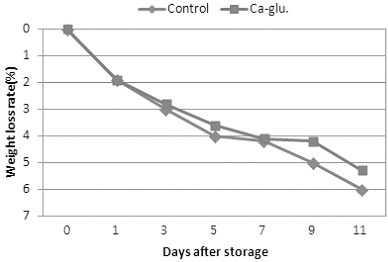
The slope of weight loss in Ca-glu treatment was constantly increased until 7 DAS as 4.1% and gently increased as 4.2% at 9 DAS. Calcium retarded ripening with high fruit firmness and low lycopene content. Kim et al. (2001) showed that silicate application in tomato hydroponics induced long shelf-life by acceleration of Ca uptake and low CO2 production. Final weight loss rates were lowered in Ca-glu treatment than control. These results suggested that Ca in fruit may inhibit tomato weight loss.
Effects of Ca-glu on Fruit Firmness
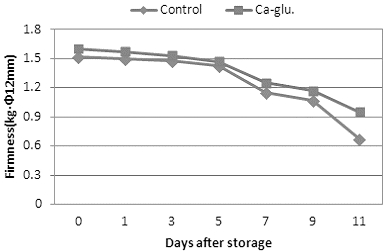
Application of Ca ions inhibits respiration, prevents ethylene production, delays senescence, alleviates various physiology disorder, and increased resistance to fungal infection (Tingwa and Young, 1974). Before storage, tomato fruit firmness of control and Ca-glu treatment were 1.52- and 1.60 kg φ 12 mm-1. Tomato fruit firmness was gently decreased from 1 to 5 DAS (Fig. 2). Fruit firmness of control was more rapidly decreased than Ca-glu treatment at 5 DAS which were 1.43 and 1.47 kg φ 12 mm-1, respectively. Fruit firmness of control was more rapidly decreased than Ca-glu treatment from 5 to 11 DAS and final fruit firmness in control and Ca-glu treatment were 0.67 and 0.95 kg φ 12 mm-1, respectively. Ca-glu treatment may be affected on fruit firmness. Moon et al. (2002) showed that the persimmon than non-treated fruit at fruit at the harvest and storage. Calcium works in maintenance of tomato firmness by depression of PG or PE activity, and maintained cell wall coherence (Poovaiah, 1986).
Fruit color Assessment by Hunter’s ‘a’ value
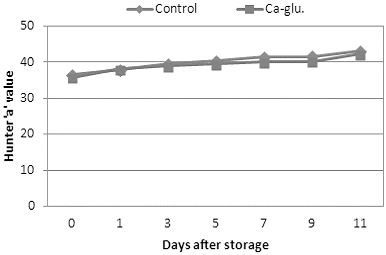
Hunter’s ‘a’ value means redness when positive, and greenness when negative. Hunter’s ‘a’ value was increased during storage. Hunter’s ‘a’ value of Ca-glu treatment was more gently increased as from 35.8 to 42.3 than that of control as from 36.5 to 43.1 (Fig. 3). No difference showed in Hunter’s ‘a’ value between control and Ca-glu treatment. It can be suggested that tested tomatoes were harvested at vine-red ripe stage in this experiment. Hunter’s ‘a’ value represents red pigment, lycopene. The a/b values of tomato fruit skin color were maintained lower at low and high temperature because lycopene reduced by ethylene production depression (Kader, 1985). Kim et al. (1996) showed that the a/b values of tomato fruit skin color were maintained lower on fruits stored at 5, 10, 30 and 35°C than those stored at 15, 20 and 25°C.
Determination of total carotenoid content
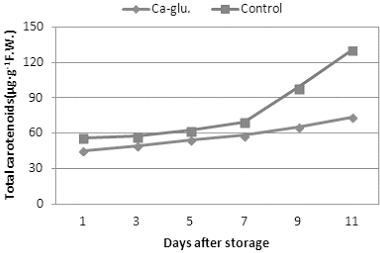
The pigments in tomato fruit belong to carotenoids. The representative pigments of tomato were lycopene and β- carotene. Lycopene and β-carotene were regarded as the two kinds of carotenoids. In tomato, Lycopene contains about 90% of total carotenoids. Total carotenoids of control and Ca-glu treatment were gently increased to 5 DAS, AS 56- TO 62.4 μg·g-1 FW and 45.6- to 54.4 μg·g-1 FW, respectively (Fig. 4). Total carotenoids of control was rapidly increased, from 7 to 11 DAS, as 130.4 μg·g-1 FW, but those of Ca-glu treatment was gently increased as 58.4 to 73.6 μg·g-1 FW. These results revealed that ripening of tomatoes may be delayed due to Ca-glu treatment. These results were agreed to the report of Will et al. (1977) whereas Ca treated tomatoes retarded coloring and ripening. Pigment levels were similar regardless of treatment and harvest date, but did not show any variation depending on the fruit’s position along the truss. On harvest day the last fruit on the truss contained low levels of pigments as compared with the first fruits (Kagan-Zur and Mizrahi, 1993).
Influences of Lycopene content on Ca-glu
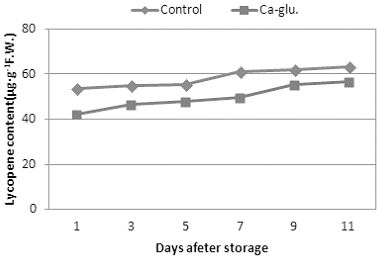
Lycopene is the main red color pigment of tomatoes and works as antioxidant and anticancer in human. Lycopene content of control was markedly increased from 5 to 7 DAS, but those of Ca-glu treatment was rapidly increased from 7 to 9 DAS (Fig. 5). Lycopene content of control was higher as 63.3 μg·g-1 FW than Ca-glu treatment as 56.8 μg·g-1 FW. Lycopene is thought to the main pigment responsible for red color of tomato fruit (Meredith and Purcell, 1966). The concentration of two pigments, β-carotene and especially lycopene increased through ripening. Red color development was affected by lycopene production (Frenkel and Garrison, 1976). In color development, respiration, and ethylene production, postharvest ripening showed same pattern between normal tomatoes and ripening inhibitor (rin) tomatoes (Hong and Lee, 1996). Kopeliovitch et al. (1979) found that non-ripening hybrids a long shelf-life, and are usually picked red, as color and flavor accumulate best when fruits are allowed to vine-ripen. Tigchelaar et al. (1978) reported that coloring in rin was delayed, and softening occurred long after normal fruit become overripe. PG activity and softening was not appeared when tomatoes were harvested at mature green stage and stored at 33°C for 15 days (Yoshida et al., 1984).
Effects of Polygalacturonase (PG) activity on Ca-glu
PG activities were determined as D-galacturonic acid. PG activity of control was higher than Ca-glu treatment during storage. PG activity of control was rapidly increased with increasing storage period as from 0.4 to 1.2 units (Fig. 6). PG activity of Ca-glu treatment was slowly increased from 1 to 7 DAS, and rapidly increased 7 to 11 DAS. Park and Lee (1988) reported that PG, PE and β-galactosidase represent softening enzymes of tomatoes. In non-climateric fruits, ripening may be delayed in the way that ethylene production and PG synthesis progress more slowly during ripening. PG was not detected in mature green tomato fruit (Assi et al., 1997).
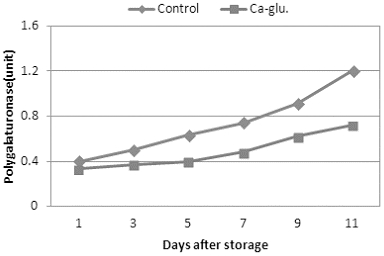
Fig. 6.
Seasonal changes in polygalacturonase activity of tomato fruit as affected by calcium gulconate.Ripening of tomato fruit is accompanied by major changes in the pectin components of the cell walls. This is examplified by increased solublity, deploymerisation and de-esterification of the pectin with major changes in the pectin components of the cell wall (Tucker and Grierson, 1987; Fisher and Bennett, 1991).
Ahrens and Huber (1990) showed that ethylene accelerated fruit ripening and reduced firmness by increasing PG and cellulase activity. PG activity was less strongly affected in irradiated pink fruit in mature-green fruit, but activity remained reduced relative to the controls (Assi et al., 1997).
Effects of Pectinesterase (PE) activity on Ca-glu
The enzyme activity of softening has been increased during development and ripening stage. PE activity of control and Ca-glu treatment at 1 DAS was 52.5 and 49.7 units, respectively (Fig. 7). PE activity of control was rapidly increased from 3 to 7 DAS as 54.8 to 64.5 units, and those of CA-glu treatment was markedly increased from 3 to 5 DAS, and from 7 to 9 DAS. PE activity of control was higher than Ca-glu treatment. From these results, high Ca content of tomato was declined by the PE activity, and eventually retarded softening. Warrilow et al. (1994) reported that PE activity is present throughout fruit development and ripening and arises from at least three isoforms, which likely to be separate gene products.

Fig. 7.
Seasonal changes in pectinesterase activity of tomato fruit as affected by calcium gulconate.PE and β-galactosidase activities were significantly enhanced in irradiated fruit of both ripening stages in the early period following irradiation, but reductions were noted after prolonged storage (Assi et al., 1997). PE activity was also reduced with levels in transgenic plants showing on average of 1% in Wildtype activity (Simons and Tucker, 1999). Different isoforms of PE have been reported in tomatoes (Pressey and Avants, 1972). Gaffe et al. (1994) showed that there are two major groups of PE isoforms in various tissues of tomatoes.
Effects of β-carotene activity on Ca-glu
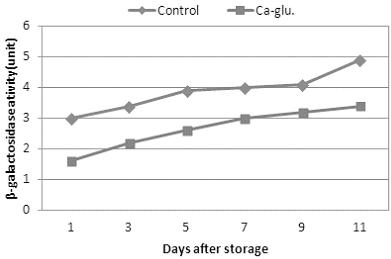
β-galactosidase is one of the main softening enzymes in tomato (Gross, 1990) and major cell wall hydrolases in peach (Lee et al., 2003). β-galactosidase activity of control at 1 DAS was twice high compared to Ca-glu treatment (Fig. 8). β- galactosidase activity of control was rapidly increased from 1 to 5 DAS as from 3.0 to 3.9 units, and from 9 to 11 DAS as from 4.1 to 4.9 units. β-galactosidase activity of Ca-glu treatment was rapidly increased from 1 to 7 DAS as from 1.6 to 3.0 units, and gently increased from 7 to 11 DAS as from 3.0-3.4 units. β- galactosidase activity of control were higher than Ca-glu treatment. The lower PE activity was present in the fruit treated at the Ca-glu treatment. From obtained results in this experiment, Ca treatment of tomato was retarded softening. Moon et al. (2002) showed that there was no difference in α- and β- galactosidase activity at harvest, but these activities were lower in stored fruit of liquid Ca compounds. Paliyath et al. (1984) reported that calcium ion treatment results in preserving the membrane structure and the cellular compartmentation longer, delaying the senescent breakdown.