


As one of aliied species of Prunella vulgaris var. lilacina, ‘Prunella vulgaris for. albiflora Nakai’ belonging to Prunella vulgaris var. lilacina family is a perennial plant which bear the white colored flower. Therefore, its scarcity is recognized compared to Prunella vulgaris var. lilacina that producing purple flowers. In Korea, it is mainly used for medicine and nectar source but supply is limited compared to demand and the method of cultivation is very primitive and there is little full-fledged research for the improvement of varieties and cultivation methods.
The artificial induction of tetraploid plants is generally being made a lot by varying concentration, treatment time and treatment method etc. Colchicine is known to be the inhibition of the formation of spindle fibers by combining tubulin in the process of somatic cell division of plants and induces polyploidization of chromosome by interfering with the formation of microtubules and anodal movement of chromosome in the middle stage of cell division (Hadlaczky et al., 1983).
In general, organs or stems of tetraploid plants become larger (Cockerham and Galletta, 1976; Lapins, 1975) and stems get thicker and longer and leaves and flowers get larger as well. In addition to polyploidization, particularly, the component content of secondary metabolite such as sugars in candy cane, vitamin C in fruit of tomatoes and apples, nicotine in tobacco leaves etc. are changed and characteristics such as virus-free resistance (Hahn, 1969), freezing resistance of mulberry (Park, 1994) etc. are improved in some cases.
Generally, methods to identify polyploidy were regarded as the observation of pollen grains (Bamberg and Hanneman, 1991), number of chloroplast (Chaudhari and Barrow, 1975; Dudley, 1958; Bae et al., 2001), stomatal cells (Borrino and Powell, 1987), marker genes such as 'seed maker' or ‘embryo maker’ (Bingham, 1969; Verdenius, 1973; Nonda and Chase, 1966), characteristics of the plant (Gaines and Aase, 1926; Hougas and Peloquin, 1957) but the analysis method by the amount of intracellular DNA and chromosome observation known as the most accurate methods were mainly used (Galbraith et al., 1983; Miyoshi and Asakura, 1996; Sari et al., 1999). However, the disadvantages of the method by chromosome when usually used that some technical problems and efforts were accompanied and a large amount of materials cannot be examined. Currently, therefore, polyploidy is determined by simply measuring DNA content with flow cytometry that can analyze a large amount of materials accurately.
In order to obtain basic data for cultivating superior varieties of ‘Prunella vulgaris for. albiflora Nakai’, this study were conducted to examine the appropriate materials and appropriate concentrations, soaking time, etc. and to find out the effective induction method of tetraploid plants by colchicine treatment.
MATERIALS AND METHODS
Tetraploid cultivation by colchicine treatment
Seeds of 'Prunella vulgaris for. albiflora Nakai' were grown in 2013 and explants of cultured plants were grown after in vitro sterilization that were used as experimental materials. For treatment, 20 ml of 0.01, 0.05, 0.1 and 0.5% colchicine solution were applied in Petridish on which 50 seeds were soaked and left for 1, 3, 6 and 12 hours under the low temperature condition (5°C). Each treatment was repeated 3 times. After soaking, each seed was washed 3~4 times with sterile water and then, it was sown in bed soil for gardening and sprouted in the constant temperature room of 25°C. Germination was investigated when cotyledons emerged and leaves were collected when more than 6 foliage leaves emerged to check the presence or absence of polyploidy.
Also, in order to treat explants of cultured plants, 40 ml of 0.01, 0.05 and 0.1% colchicine solution was put in a beaker of 10 ml and then the nodes of ‘Prunella vulgaris for. albiflora Nakai’ were cut to a length of about 1cm and soaked for 1, 6 and 12 hours. After soaking, each explant was washed with sterile water 3~4 times and then 5 explants were placed in MS medium and each treatment was repeated 9 times. Culture was made at 25±1°C and illuminated for 16 hours by luminosity of 40 μmol·m-2·s-1.
DNA content analysis using cytometry
The plant leaf of each treatment plot was cut to a size of about 0.5 × 0.5 cm and then, HR-A solution (Patec Inc., Germany) was added and then the tissue was crushed to extract DNA. HR-B solution (Patec, Germany) was added to this solution for staining and then, doubling of DNA content was checked by using Flow cytometry (Patec PA-1, Germany) and polyploidy was determined through this result.
Investigation of the number of chloroplasts in guard cells
In order to observe chloroplasts, it was stained by separating the back side of leaves collected in the middle part of the plant to cut the back side epidermis and then, immersed it in iodinepotassium solution (1%(w/v) iodine, 2%(w/v) potassium iodide) for 2~3 hours and stained back side epidermis was examined through a microscope. To count the number of chloroplasts in guard cells, 30 cells were investigated in leaves of three objects per repetition and then the average was calculated.
RESULTS AND DISCUSSION
Seed soaking treatment of colchicine
Seed germination rate and polyploid induction rate were investigated by different concentration and soaking duration of colchicine in Prunella vulgaris for. albiflora Nakai seeds and the results were shown in Table 1.
Table 1.
Effect of colchicine on chromosome doubling and germination in Prunella vulgaris for albiflora Nakai.
| Conc. (%) | Soaking time (hrs) | No. of seeds treated | No. of seeds germinated | % of germination | No. of tetraploids |
|---|---|---|---|---|---|
| Control | 50 | 43.6 | 87.3az | - | |
| 0.01 | 1 | 50 | 35 | 70.0ab | - |
| 0.05 | 50 | 30.3 | 60.7bc | - | |
| 0.1 | 50 | 28 | 56.0bcd | - | |
| 0.5 | 50 | 20.3 | 40.7def | 1 | |
| 0.01 | 3 | 50 | 31.6 | 63.3bc | - |
| 0.05 | 50 | 26.6 | 53.3bcd | - | |
| 0.1 | 50 | 20.6 | 41.3def | 2 | |
| 0.5 | 50 | 15.6 | 31.3efg | 2 | |
| 0.01 | 6 | 50 | 23.3 | 46.7cde | 1 |
| 0.05 | 50 | 19.6 | 39.3def | 7 | |
| 0.1 | 50 | 11.6 | 23.3fgh | 5 | |
| 0.5 | 50 | 9.3 | 18.7gh | 2 | |
| 0.01 | 12 | 50 | 15 | 30.0efg | 3 |
| 0.05 | 50 | 7.3 | 14.7gh | 2 | |
| 0.1 | 50 | 4.6 | 9.3h | 2 | |
| 0.5 | 50 | 3 | 6.0h | 1 | |
The germination rate of seeds were tended to decrease when the higher the concentration of colchicine and the longer the soaking duration. In particular, in the case of 12-hour soaking treatment, the germination rate was found to be significantly suppressed to the range of 6~14.7 % in the concentration plot of more than 0.05%. Total 907 individuals showed 37.8% of germination rate that were germinated in 16 colchicine treated plots except for control (untreated plot). In order to check polyploidy, GAIN value of flow cytometry was fixed to 520.0 and then the DNA content of leaves was investigated. The result revealed that DNA content peak of G1 phase was doubled to 101.3 in diploid (control plot), 197.2 in tetraploid. M1 plants of tetraploid in which DNA content was observed doubled and as a result, 28 tetraploid plants with 3.1% content could be obtained (`. 1).

Fig. 1.
Comparison of DNA contents in diploid and tetraploid of Prunella vulgaris for albiflora Nakai. Flow histograms showing DNA measurements of nuclei from leaves.In order to increase the efficiency of tetraploid induction, seeds were treated with colchicine. Results showed that the induction efficiency of tetraploid plants could be observed higher in the longer duration of soaking time compare to soaking concentration. Also, when colchicine was treated for 6 hours or 12 hours regardless of the high and low concentrations of colchicine, there were differences in the tetraploid induction efficiency but tetraploid plants were inducted in all concentration plots. In particular, 5 and 7 tetraploid plants were obtained when treated for 6 hours at concentrations of 1% and 0.05, respectively, showing the highest induction of tetraploid plants.
From the above results, colchicine concentrations (ranges from 0.05~1%) and treatment duration 6 hours were considered to be suitable concentration and soaking time of colchicine seed treatment for tetraploid plant induction of Prunella vulgaris for. albiflora Nakai.
Prunella vulgaris for. albiflora Nakai identified as tetraploid was transplanted in pots filled with bed soil for gardening and cultivated for 2 months and then, the growth of the aerial part was investigated. The results are shown in Table 2 and Fig. 2. It was prevailed that the plant length of tetraploid plants was longer about 1.3 cm than that of diploid plants while the leaf length of diploid plants was longer. There were no differences in leaf width and petiole length between diploid and tetraploid plants while leaf number of tetraploid was found to be more by about 4 leaves (Table 2). Generally, in the case of tetraploid plants, stems are known to get thicker and leaves and flowers are also larger due to the expansion of organs or tissues (Cockerham & Galletta, 1976; Kim et al., 2003) but Prunella vulgaris for. albiflora Nakai showed no significant difference except for significantly long plant length and leaf length. These results are considered to result from morphological differences in the early stage of growth.
Table 2.
Comparison of growth characteristics in diploid and tetraploid of Prunella vulgaris for albiflora Nakai.
| Ploidy | Plant height (cm) | Leaf length (cm) | Leaf width (cm) | No. of leaves | Petiole length (cm) |
|---|---|---|---|---|---|
| Diploid | 3.0±0.4bz | 3.1±0.2a | 2.2±0.2a | 13.5±1.0b | 2.7±0.1b |
| Tetraploid | 4.3±0.6a | 2.3±0.3b | 2.2±0.3a | 17.3±1.3a | 2.7±0.5b |
Looking at the morphological characteristics of tetraploid plants shown after colchicine treatment, several forms of tetraploid plants could be observed such as small or large plants compared to diploid plants. In particular, a lot of egg-shaped tetraploid objects could be seen compared to diploid with lanceolate leaves. In addition, diploid plants have the soft and thin leaf tissue and leaf color is also green while tetraploid plants showed the characteristics of thicker mesophyll tissue and dark green leaf color compared to diploid plants (Fig. 2).

Fig. 2.
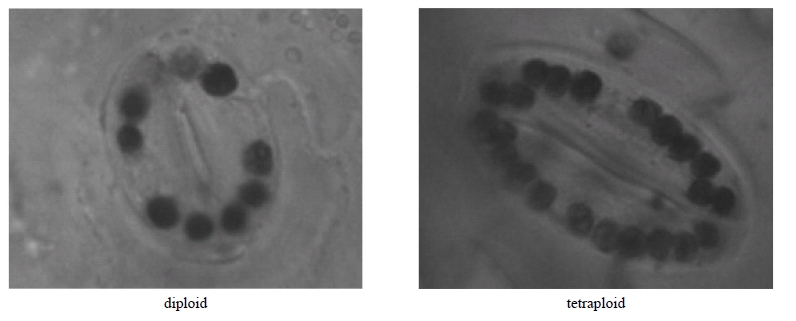
Comparison of morphologic characteristics in diploid and tetraploid of Prunella vulgaris for albiflora Nakai.The number of chloroplasts of guard cells of diploid and tetraploid of Prunella vulgaris for. albiflora Nakai is shown in Fig. 3. As for the number of chloroplasts per guard cell, diploid plants have 10 chloroplasts and tetraploid plants 19.3 and tetraploid was found to have about two times more chloroplasts than diploid. These results were very similar to the results that the number of chloroplasts in guard cells according to polyploidy of potatoes significantly increases, 12.2 in haploid, 18.4 in triploid and 20.2 in tetraploid as polyploidy is increased (Cho et al., 1994) and even for tobacco, the number of chloroplasts in guard cells also increases as polyploidy increases (Bae et al., 2001).
In vitro cultured explant soaking treatment of colchicine
The effects of soaking treatment concentration and time duration of colchicine on polyploid induction of Prunella vulgaris for. albiflora Nakai explants being cultured in vitro and plant regeneration are shown in Table 3 and Fig. 4.

Fig. 4.
Comparison of DNA contents in diploid and tetraploid of Prunella vulgaris for albiflora Nakai. Flow histograms showing DNA measurements of nuclei from leaves.Table 3.
Effect of colchicine on chromosome doubling and plant regeneration in Hypericum patulum Thunberg.
| Conc. (%) | Soaking time (hrs) | No. of explants treated | No. of explants regenerated | % of regeneration | No. of tetraploids |
|---|---|---|---|---|---|
| 0.01 | 1 | 45 | 44 | 97.8az | 0 |
| 0.05 | 45 | 42 | 93.3b | 2 | |
| 0.1 | 45 | 37 | 82.2ab | 3 | |
| 0.01 | 6 | 45 | 41 | 91.1b | 6 |
| 0.05 | 45 | 36 | 80.0ab | 18 | |
| 0.1 | 45 | 28 | 62.2bc | 11 | |
| 0.01 | 12 | 45 | 39 | 86.7ab | 5 |
| 0.05 | 45 | 28 | 62.2bc | 19 | |
| 0.1 | 45 | 17 | 37.8c | 4 | |
405 explants of Prunella vulgaris for. albiflora Nakai were treated with colchicine and as a result, 312 individuals were regenerated at all concentrations, showing 77.0% of regeneration rate and the number of regenerated plants showed a tendency of lowering at the high concentration of colchicine and the longer period of time. In order to check polyploidy, the DNA content of regenerated 312 individuals was investigated after fixing GAIN value of flow cytometry to 490.0 and as a result, DNA content peak of G1 phase was found to be 100.4 in diploid and 201.1 in tetraploid, showing that DNA content is doubled (Fig. 4). The DNA content of regenerated 312 individuals was analyzed and as a result, tetraploid plants were obtained from a total of 68 objects, showing the high induction rate of 21.8%. Tetraploid plants were inducted in all treatment plots except for colchicine 0.01% at 1 hour soaking treatment plot. However, in the case of plots treated for 6 and 12 hours at the concentration of 0.05%, and the inducted 18, 19 tetraploid plants showed the highest results respectively. These results were very similar to the results that the tetraploid plants induction using in vitro culture of Hypericum perforatum, the highest induction rate was shown when immersed with colchicine 0.05% for 12 hours (Kwon et al., 2013).
The above results showed that induction of tetraploid plants using in vitro culture was found to be about 7.0 times higher than the tetraploid induction rate of 3.1% obtained during seed treatment. So, it is more effective to treat colchicine in explants of in vitro culture showing vigorous cell division than directly treat it in seeds and may be used as a way of efficient induction of tetraploid plants.
The characteristics of tetraploid plants after colchicine treatment observed that leaf area gets wider and the form of the petiole gets thicker and shorter compared to diploid. It was observed that diploid carried the weak and thin leaf tissue and leaves were also light green while tetraploid plants showed the characteristics of thicker mesophyll tissue than diploid and leaf color of dark green (Fig. 5).