
Original Research Article

The Korean Journal of Crop Science. 1 December 2022. 285-295
https://doi.org/10.7740/kjcs.2022.67.4.285

ABSTRACT


MAIN

  • INTRODUCTION

  • MATERIALS AND METHODS

  •   Study site

  •   Selection of traps

  •   Evaluation of pheromones

  •   Meteorological data

  •   Statistical analysis

  • RESULTS

  •   Evaluation of pheromones

  •   Population dynamics of S. frugiperda and M. loreyi

  •   Relationship between moth populations and weather parameters

  • DISCUSSION

INTRODUCTION

The fall armyworm, S. frugiperda, is an intrusive noctuid transitory pest, native to tropical and subtropical regions of the Americas (Goergen et al., 2016; Luginbill, 1928; Sparks, 1979). Since its first detailed attack in 1797, a significant attack was recorded in Africa in 2016, when this pest was recognized in over 44 nations in sub-Saharan Africa (Goergen et al., 2016; Prasanna et al., 2018) and rapidly migrated into several Asian nations, including Bangladesh, China, Laos, Myanmar, Nepal, Sir Lanka, Thailand, and Vietnam (Bajracharya et al., 2019; Ma et al., 2019; Sharanabasappa et al., 2018). In Korea, S. frugiperda was first noticed on June 13, 2019, at Jeju Island, and has since spread to most provinces in Korea (Lee et al., 2020). S. frugiperda has several plant hosts, with more than 350 plant species known to be vulnerable to associated economic losses (Chapman et al., 2000; Montezano et al., 2018). Among these plant hosts, maize is the most vulnerable with yield losses due to S. frugiperda reported to be more than 70% (Baudron et al., 2019; Harrison et al., 2019; Johnson, 1987). Due to its long distance migratory behavior travelling up to 62.98 km (Ge et al., 2019), the risk of spread is high, as shown by the capture of S. frugiperda on Jeju Island Korea far from the continent.

The rice armyworm, M. loreyi is a noctuid pest of several grain crops such as rice, wheat, barley, broom corn, maize, and cash crops, including sugarcane (Aloysius, 2012; El-Sherif, 1972). In Korea, M. loreyi is a serious economic pest of soybeans and maize (Jung et al., 2020). M. loreyi frequently occurs with the closely related species M. separata (Walker), and can cause significant crop damage and economic losses (Guo et al., 2003; Hirai, 1975; Jiang et al., 2014).

Several studies on M. separate, S. exigua, Helicoverpa armigera, and Riptortus clavatus have been undertaken in Korea (Jung et al., 2003, 2005, 2013, 2015), however, understanding of the population dynamics of S. frugiperda and M. loreyi remains limited despite being crucial for developing appropriate population monitoring tools, forecasting models, and management strategies. Species-specific sex pheromones play a crucial role in the decision-making process before the adoption of any management option such as the timing of pesticide application (Ahmad & Kamarudin, 2011; Cruz et al., 2012). In pest management programs, a variety of sex pheromones have been successfully used for insect monitoring, mass trapping, and mating disruption of a wide range of insect species (Ahmad & Kamarudin, 2011; Baker & Heath, 2005; Campion, 1983; Guerrero et al., 2014; Howse et al., 1998; Keathley et al., 2013; Ridgway et al., 1990; Spears & Ramirez, 2015). Thus, sex pheromones can contribute to integrated pest management strategies by modifying insect behavior and via the mass-capturing of adult insect pests (Ahmad & Kamarudin, 2011). The use of sex pheromone-baited traps is a common and well-established technique, especially for trapping lepidopterans (Mullen & Dowdy, 2001). As a newly invaded pest in Korea (Lee et al., 2020), strategies for S. frugiperda management remain understudied, and an evaluation of existing sex pheromones and traps in Korea has not been undertaken. Although S. frugiperda can only successfully breed in the summer and cannot survive over winter on the Korean peninsula due to extreme temperatures, there is a significant potential for population increases, spreading, and increased damage with the effects of rapid climate change (Maharjan & Jung, 2011). Indeed, the spread and persistence of these insect pests are closely related to geographical location, ecological environment, and climatic conditions on the Islands of Japan and in eastern China (Ma et al., 2019). Therefore, invasion by S. frugiperda and M. loreyi has seriously threatened the production of field crops in Korea, including soybean and maize, and ultimately, food security. Furthermore, there is an urgent need to monitor the populations of these moths to predict the invasion risk in Korea. Early population detection can offer many benefits and help reduce management costs by adopting proper spray timing and minimizing pesticide applications as well as the overall advancement of alternative pest management options. Therefore, we evaluated the capture efficacy of commercially available sex pheromones to better understand the population dynamics of S. frugiperda and M. loreyi and their association with a range of weather parameters in southern Korea.

MATERIALS AND METHODS

Study site

The study was conducted in 2019 in maize fields (1 - 2.5 ha) at the Department of Southern Area Crop Science, National Institute of Crop Science, Rural Development Administration, Miryang, Gyeongsangnam Province, 35° 49’N, 128° 74’E), Korea. The pheromone evaluation was conducted between April and November 2019 as part of a population dynamics study.

Selection of traps

To monitor the moths, funnel traps were used (Pherobank, green lid/green funnel/transparent bucket; 17 cm dia. × 23 cm H, 3960 BA Wijk bij Duurstede, Netherlands). Funnel traps are also known as universal moth traps (unitrap) and Multipher traps, and are commonly used for capturing lepidopteran insects (Epsky et al., 2008).

Evaluation of pheromones

One commercial trap design (funnel trap) and five types of commercial sex pheromones manufactured in different countries (Korea, Netherlands, North America, China, and Costa Rica) were evaluated under field conditions. Traps without lures were used as the controls. The funnel traps were baited with aggregated sex pheromones manufactured in different countries and used as treatments. The traps with lures were hung on steel rods using brackets approximately 1 m from the ground inside the maize fields. The positions of the traps were randomly assigned, maintaining at least 10 m between traps, and each trap was randomly rotated from its original position at 7 - 10 d intervals. The baited sex pheromones were replaced with new ones every month. The traps were first installed on April 20, 2019, in maize fields. Three funnel traps (field/country) were used to monitor the moths, and traps were replicated three times. Moths were collected and counted every 2 - 5 d in labeled bags.

Meteorological data

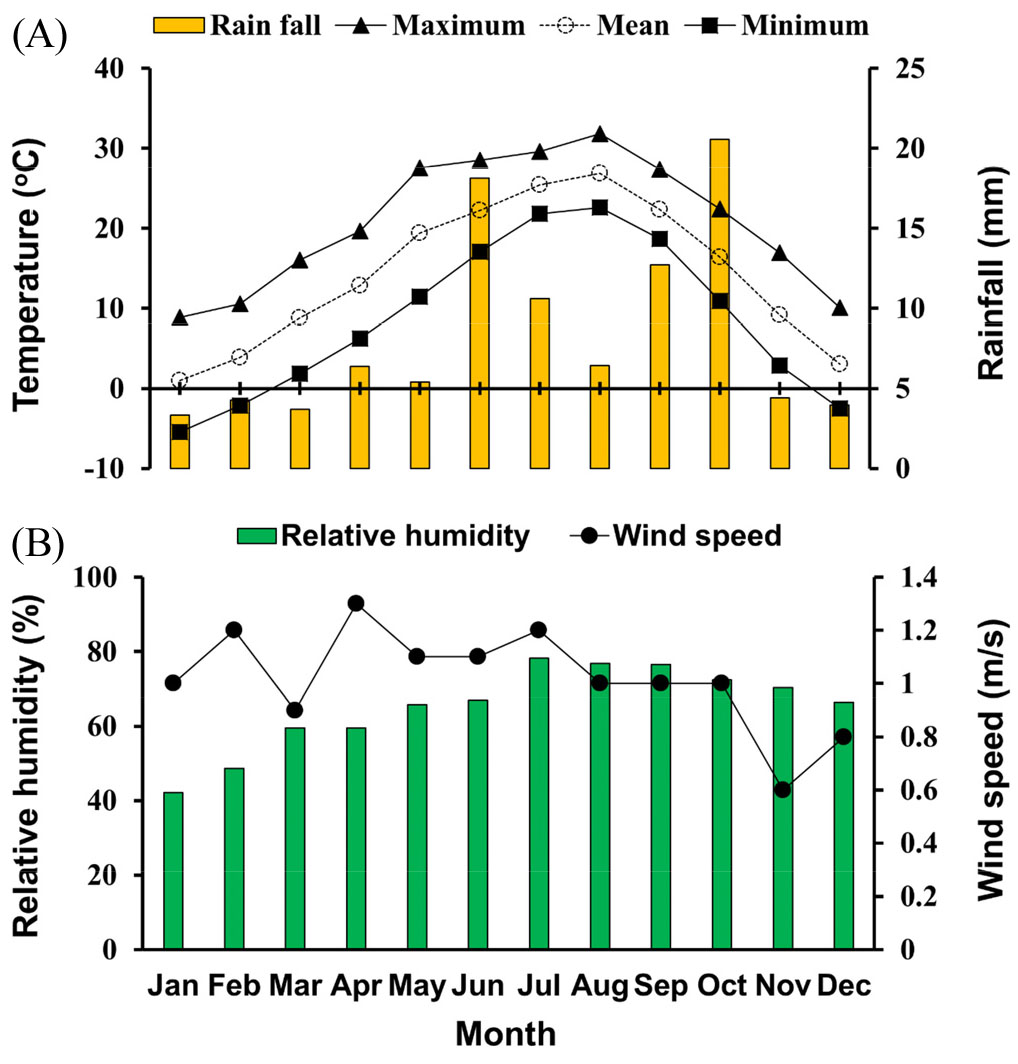
Weather data were obtained from the Korean Meteorological Administration (http://data.kma.go.kr/), focusing on the Miryang meteorological station in Gyeongsangnam Province, Korea. The weather conditions of the study area were evaluated to determine their relationships with the S. frugiperda and M. loreyi populations. Maximum temperature, minimum temperature, mean temperature (°C), relative humidity (%), rainfall (mm), and wind speed (m/s) were considered as summarized in Fig. 1.
https://cdn.apub.kr/journalsite/sites/kjcs/2022-067-04/N0840670409/images/kjcs_2022_674_285_F1.jpg
Fig. 1.

Monthly weather conditions during the monitoring period in Miryang, Gyeongnam Province, during 2019. Maximum, mean and minimum temperature, and rainfall (A); relative humidity and wind speed (B) (KMA, http://data.kma.go.kr/).

Statistical analysis

Data on capture counts were square-root transformed to meet the assumptions of normality and homogeneity of variance, and the effectiveness of each pheromone was evaluated using one-way ANOVA and PROC GLM (SAS Institute, 2000). The treatment means were compared using Tukey’s test for post-hoc analysis at P > 0.05. The correlations between the populations of S. frugiperda and M. loreyi and the weather parameters were analyzed using a General Linear Model (GLM). All analyses were performed using SAS software (SAS Institute, 2000).

RESULTS

Evaluation of pheromones

All treatments (sex pheromones) attracted both S. frugiperda and M. loreyi (Table 1), although the number of moths captured by each treatment was significantly different (S. frugiperda, F4, 514 = 20.84, P < 0.0001; M. loreyi F4, 514 = 33.35, P < 0.0001; total, F4, 514 = 47.89, P < 0.0001). The sex pheromones manufactured in Costa Rica captured significantly more moths (0.816/trap) of both species, and the lowest number of moths (0.009/trap) were captured by those manufactured in the Netherlands. However, there was no significant difference in the number of S. frugiperda captured using the sex pheromones manufactured in Korea, the Netherlands, North America, and China, nor the number of M. loreyi captured using the sex pheromones manufactured in Korea, the Netherlands, and China.

Table 1.

Number (mean ±SE) of Spodoptera frugiperda and Mythimna loreyi moths captured in funnel traps with sex pheromones manufactured in different countries.

Country No. of adults captured/ trap
S. frugiperdaM. loreyi Total
Korea 0.065 ± 0.02b 0.194 ± 0.08c 0.259 ± 0.08c
The Netherlands 0.009 ± 0.01b 0.435 ± 0.11c 0.444 ± 0.11c
North America 0.065 ± 0.03b 2.065 ± 0.44b 2.130 ± 0.44b
China 0.037 ± 0.02b 0.204 ± 0.07c 0.241 ± 0.08c
Costa Rica 0.816 ± 0.20a 4.414 ± 0.78a 5.230 ± 0.79a

Means followed by the same letters in a column are not significantly different among pheromones (ANOVA, Tukey’s [HSD] test, P <0.05)

Population dynamics of S. frugiperda and M. loreyi

S. frugiperda

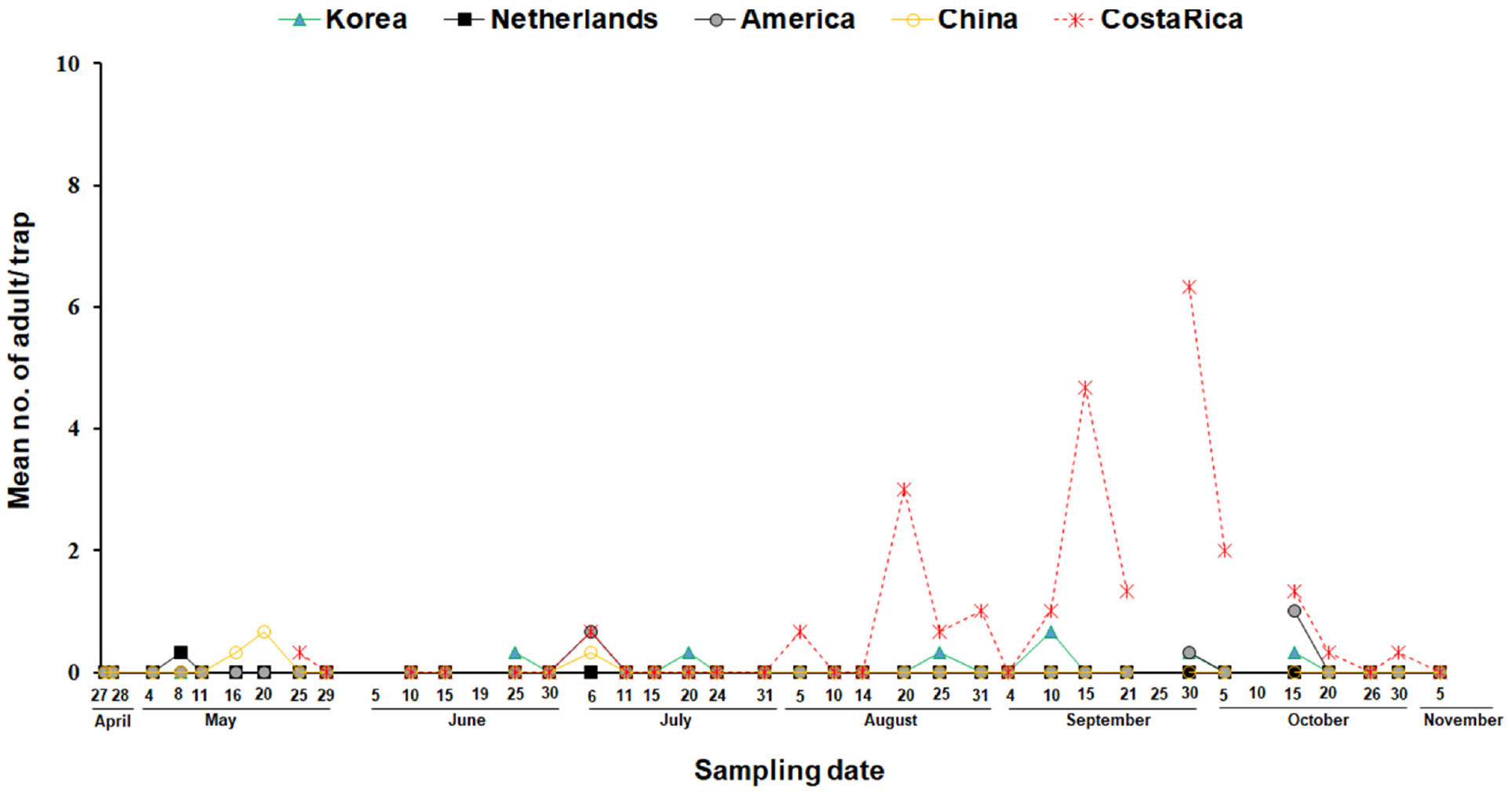
Population dynamics data show that each sex pheromone recorded different moth population peaks. For the sex pheromones manufactured in Korea, Netherlands, North America, China, and Costa Rica, we noted five population peaks during June (4th week), July (3rd week), August (4th week), September (2nd week) and October (2nd week); one peak during May (2nd week); three peaks during July (1st week), September (4th week) and October (3rd week); two peaks during May (3rd week) and July (1st week); and more than five peaks during May (4th week), August (1st, 3rd, and 4th weeks), September (3rd and 4th weeks), and October (2nd and 4th weeks), respectively. In general, few moths were captured other than when using the traps with the sex pheromones manufactured in Costa Rica. For theses specific sex pheromones, during May, the first observed and re-observed in June and August, during August was the first, September was the second, and September had the third largest population increase, which then began to decline (Fig. 2).
https://cdn.apub.kr/journalsite/sites/kjcs/2022-067-04/N0840670409/images/kjcs_2022_674_285_F2.jpg
Fig. 2.

Seasonal occurrences of Spodoptera frugiperda moths in funnel trap with different types of sex pheromones manufactured in Korea, the Netherlands, North America, China, and Costa Rica.

M. loreyi

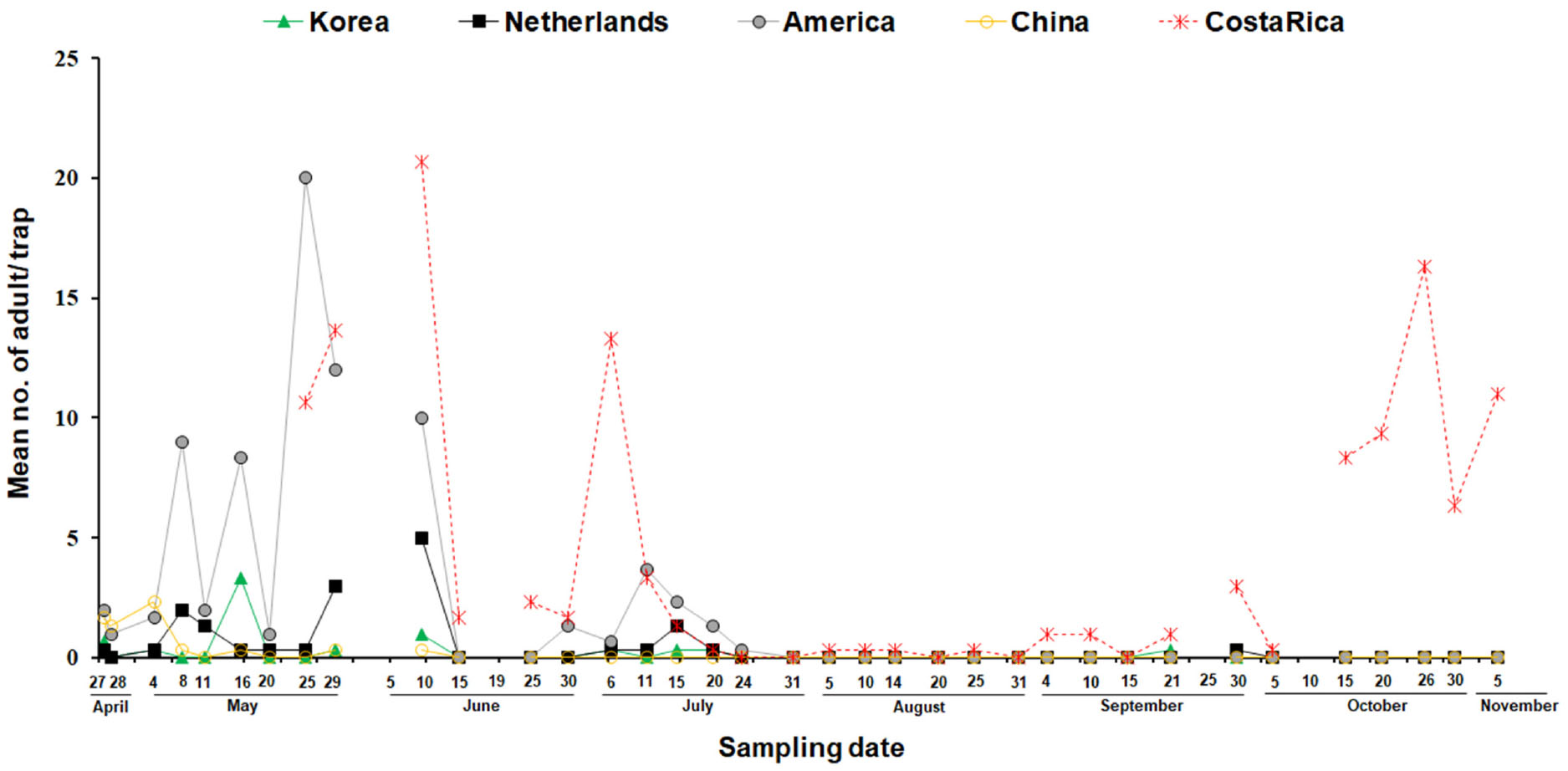
The traps with each of the sex pheromones recorded different moth population peaks. We noted one population peak during May (2nd week), and May (1st week) based on capture using the sex pheromones manufactured in Korea and China, respectively, whereas for those manufactured in the Netherlands, North America, and Costa Rica, two peaks were observed during May (4th week) and June (2nd week); five peaks were observed during May (2nd, 3rd, and 4th weeks), June (2nd week) and July (2nd week); and four peaks were observed during May (4th week), June (2nd week), July (1st week), and October (3rd week), respectively. At the beginning of May, the highest numbers of moths were trapped using the sex pheromones manufactured in North America and Costa Rica. For those manufactured in North America, the first, second, and third-largest population increases were observed in May, June, and July, respectively, while a fourth population increase was also observed in October based on capture using the pheromones manufactured in Costa Rica (Fig. 3).
https://cdn.apub.kr/journalsite/sites/kjcs/2022-067-04/N0840670409/images/kjcs_2022_674_285_F3.jpg
Fig. 3.

Seasonal occurrences of Mythimna loreyi moths in funnel trap with different types of sex pheromones manufactured in Korea, the Netherlands, North America, China, and Costa Rica.

Relationship between moth populations and weather parameters

S. frugiperda

The numbers of trapped S. frugiperda moths varied in relation to weather parameters (Tables 2 and 3). Specifically, population increases were associated with increasing mean temperature (F1, 10 = 12.88, P = 0.0049), rainfall (F1, 10 = 14.83, P = 0.0032), and relative humidity (F1, 10 = 7.95, P = 0.0182) based on trapping using the sex pheromones manufactured in Korea. Similarly, population increases were associated with increasing mean temperature (F1, 10 = 5.95, P = 0.0349) and relative humidity (F1, 10 = 5.90, P = 0.0355) based on trapping using the sex pheromones manufactured in Costa Rica.

Table 2.

Parameter interactions between captured Spodoptera frugiperda and Mythimna loreyi moths, mean temperature (°C) and rainfall (mm) during 2019.

Country of pheromone
manufacture
Weather variable Species  Linear regression model
y = ax + b r2P-value
Korea Mean temp. SF 0.0132x – 0.0665 0.5630 0.0049
ML 0.0149x – 0.0053 0.2344 0.1107
Rainfall SF 0.0209x – 0.0523 0.5972 0.0032
ML 0.0095x + 0.1292 0.0398 0.5343
The Netherlands Mean temp. SF 0.0012x + 0.0007 0.0312 0.5829
ML 0.0249x – 0.0678 0.2858 0.0734
Rainfall SF -0.0016x + 0.0318 0.0241 0.6299
ML 0.0253x + 0.0771 0.1242 0.2611
North America Mean temp. SF 0.0074x – 0.0193 0.1736 0.1779
ML 0.0427x – 0.0387 0.1750 0.1760
Rainfall SF 0.0192x – 0.0733 0.4912 0.0111
ML 0.0228x + 0.3825 0.0209 0.6540
China Mean temp. SF 0.005x – 0.0202 0.1358 0.2385
ML 0.0045x + 0.1198 0.0109 0.7464
Rainfall SF -0.0015x + 0.0633 0.0050 0.8278
ML -0.0041x + 0.2178 0.0040 0.8457
Costa Rica   Mean temp. SF 0.0359x – 0.1626 0.3730 0.0349
ML 0.6075x + 0.3299 0.1866 0.1608
Rainfall   SF 0.0415x + 0.0058 0.2089 0.1352
ML 0.1171x + 0.3206  0.2360 0.1093

SF- S. frugiperda; ML- M. loreyi; temp.- Temperature; Reg. P < 0.05.

M. loreyi

The numbers of trapped M. loreyi moths also varied in association with various weather parameters (Tables 2 and 3). For example, based on trapping using sex pheromones manufactured in Korea, population increases were linked to higher wind speeds (F1, 10 = 5.01, P = 0.0491). However, we found no significant relationship between any weather parameter and the population dynamics of M. loreyi based on trapping using the pheromones manufactured in the Netherlands, North America, China, and Costa Rica.

Table 3.

Parameter interactions between captured Spodoptera frugiperda and Mythimna loreyi moths, relative humidity (%), and wind speed (m/s) during 2019.

Country of pheromone
manufacture
Weather variable Species  Linear regression model
y = ax + b r2P-value
Korea RH SF 0.0095x – 0.4975 0.4429 0.0182
ML 0.0044x – 0.0778 0.0306 0.5866
Wind speed SF 0.1293x – 0.0098 0.0236 0.6335
ML 0.854x – 0.6602 0.3339 0.0491
The Netherlands RH SF 8E-05x + 0.0128 0.0002 0.9643
ML 0.008x – 0.2344 0.0448 0.5088
Wind speed SF 0.0456x – 0.0283 0.0191 0.6684
ML 1.0213x – 0.7509 0.2100 0.1340
North America RH SF 0.0075x + 0.4049 0.2721 0.0820
ML 0.009x – 0.0118 0.0118 0.7367
Wind speed SF 0.1249x – 0.0404 0.0215 0.6494
ML 2.3565x – 1.8238 0.2316 0.1132
China RH SF 0.0023x – 0.1012 0.0451 0.5074
ML -0.0045x + 0.4778 0.0170 0.6863
Wind speed SF 0.1878x – 0.1399 0.0840 0.3609
ML 1.0798x – 0.9145 0.2798 0.0770
Costa Rica   RH SF 0.0291x – 1.5486 0.3711 0.0355
ML 0.0604x – 2.6486 0.2267 0.1176
Wind speed   SF 0.094x + 0.2552 0.0011 0.9181
ML -1.5898x + 2.9108 0.0451 0.5077

RH- Relative humidity; SF- S. frugiperda; ML- M. loreyi; Reg. P <0.05.

DISCUSSION

The selection of monitoring tools (e.g., traps with sex pheromones) plays a significant role in the success of pest management programs. To overcome the problems caused by S. frugiperda and M. loreyi, timely prediction of the occurrence of these moth species can be achieved using sex pheromone-baited traps, enabling the early detection of infestation, and by formulating need-based insecticides and timely application programs (Witzgall et al., 2010). These approaches mean that insects infestation can be managed during its initial stages and therefore, economic losses can be minimized.

Several species-specific sex pheromones have been widely used to understand the population dynamics and spreading patterns of a diversity of insect species (Bae et al., 2017; Bae et al., 2019; Spears & Ramirez, 2015). In this study, we aimed to evaluate the effectiveness of commercial sex pheromones for evaluating S. frugiperda and M. loreyi population dynamics alongside the influence of a range of weather parameters.

Currently, commercial species-specific sex pheromone lures are widely used to control the populations of various insect species (Bae et al., 2017, 2019; Campion, 1983; Guerrero et al., 2014; Katherine et al., 2017; Keathley et al., 2013; Spears & Ramirez, 2015; Santanu et al., 2017; Witzgall et al., 2010). In our study, we found that sex pheromones manufactured in Costa Rica were the most effective at attracting S. frugiperda and M. loreyi moths, whereas those manufactured in the Netherlands were the least effective. This difference could be associated with multiple factors including species-specific effects, the type of dispenser used, pheromone release rates, lure longevity, and pheromone formulation alongside other possible unknown factors (Roger et al., 1989; Evenden & Gries, 2010). Indeed, the type of lure used and the components of different pheromones are known to be important factors affecting trap capture efficacy (Evenden & Gries, 2010; Malo et al., 2001; Roda et al., 2015; Reddy et al., 2018). Pheromone dosage is a key variable affecting moth trap efficacy, with higher doses typically leading to higher capture rates (Boo & Jung, 1998; Hand et al., 1987). However, the attractiveness of a particular pheromone does also vary according to species. For example, one-tenth of the standard dose of pheromone was found to provide a better indication of damage by leaf roller moth larva in orchards, and a wide range of pheromone blends has been reported to attract the diamondback moth, Plutella xylostella (Macaulay et al., 1986; Walker et al., 2003; Zilahi-Balogh et al., 1995).

The correlation analysis showed a positive relationship between S. frugiperda population and temperature, rainfall, and relative humidity based on trapping using the sex pheromones manufactured in Korea. Similarly, positive relationships between S. frugiperda and temperature and relative humidity were observed based on the sex pheromones manufactured in Costa Rica. In the case of M. loreyi, a positive relationship was also recorded with wind speed. Based on these results, temperature, rainfall, relative humidity, and wind speed have the greatest influence on the numbers of S. frugiperda and M. loreyi moths captured under agro-ecological conditions in southern Korea. Temperature is considered the most influential factor, affecting insect multiple life-history variables, insect activity, seasonality, and the behavior of field populations, population dynamics and phenology (e.g., timing of oviposition and development), and ultimately the prediction of future generations (Al-Mezayyen & Ragab, 2014; Amer et al., 2009; Angilletta, 2009; Ashley et al., 1987; Barfield & Ashley, 1987; Dahi, 2007; Danilevskii, 1965; Howe, 1967; Jaworski & Hilszczanski, 2013; Lamb, 1992; Plessis et al., 2020; Ragab, 2009; Régnière et al., 2012; Tobin et al., 2003). Indeed, insect species development is sensitive to temperature (Howe & Currie, 1964), and weather and geographical conditions are thought to have the greatest impact on a wide range of insect species including H. armigera (Dahi, 2007; Tahhan et al., 1982), H. virescens (Potter et al., 1981), S. littoralis (Taman, 1990), Liriomyza huidobrensis (Maharjan & Jung, 2016), and Callosobruchus chinensis (Maharjan et al., 2017). Furthermore, Groot et al. (2008) reported that sexual communication in several lepidopteran species is mediated by geographical variations and host strains.

Hagstrum & Hagstrum (1970) reported that insects develop quickly even at fluctuating temperatures, when the maximum and minimum temperatures are within their optimal range. Thus, by providing new data on the population dynamics of S. frugiperda and M. loreyi under local agro-ecological conditions in the southern parts of Korea, we provide important information that can support the development of location-specific integrated pest management strategies (Shanower et al., 1993). In addition, the long-term benefits of using sex pheromones based trappings over conventional insecticides can lead to longer-term reductions in pest populations (Witzgall et al., 2010).

Overall, we found that sex pheromones manufactured in Costa Rica were most effective at capturing S. frugiperda and M. loreyi moths in southern Korea. Weather parameters, such as temperature, relative humidity, and rainfall were also found to have a significant effect on the population dynamics of these species. This information can help the development of integrated pest management strategies, including the timing of insecticide application by maize growers. Further studies on the economic thresholds and damaging nature of both of the studied moth species are now needed to ensure the efficient and sustainable use of appropriate pest-management options to improve maize production in the southern parts of Korea.


CONFLICT OF INTEREST

The authors have declared that they have no conflict of interest.

Acknowledgements

This work was supported by the Cooperative Research Program for Agriculture Science and Technology Development (Project No. PJ01419704), National Institute of Crop Science (NICS), Rural Development Administration (RDA), Republic of Korea.

References

1
Ahmad, S. N. and N. Kamarudin. 2011. Pheromone trapping in controlling key insect pests: Progress and Prospects. Oil Palm Bulletin 62 : 12-24.
2
Al-Mezayyen, G. A. and M. G. Ragab. 2014. Predicting the American bollworm, Helicoverpa armigera (Hübner) field generations as influenced by heat unit accumulation. Egyptian Journal of Agricultural Research 92 : 91-99. 10.21608/EJAR.2014.154435.
3
Aloysius, S. E. 2012. Moth, Nocturnality, Noctuidae, Leucania loreyi. Commun.
4
Amer, A. E., A. A. El-Sayed, and M. A. Nada. 2009. Development of Helicoverpa armigera (Hub.) (Lepidoptera: Noctuidae) in relation to heat unit requirement. Egyptian Journal of Agricultural Research 87(3) : 667-674. https://agris.fao.org/agrissearch/search.do?recordID=EG2012000159. 10.21608/ejar.2009.196622
5
Angilletta Jr, M. J. 2009. Thermal adaptation: a Theoretical and Empirical Synthesis. Oxford University Press, New York, pp. 289. 10.1093/acprof:oso/9780198570875.001.119886501
6
Ashley, T., C. T. Elliott, A. M. White, G. J. Crimes, and A. T. Harker. 1987. Near-ambient-temperature bipolar transistor in cadmium mercury telluride. Electronics Letters. 23: 1280-1281. 10.1049/el:19870887
7
Bae, S., H. Yi, Y. N. Yoon, Y. Jang, Y. Kim, and R. Maharjan. 2019. Attraction of stink bugs to rocket traps with different combinations of wing and landing board color. Journal of Asia-Pacific Entomology 22(1) : 243-249. 10.1016/j.aspen.2019.01.007.
8
Bae, S., Y. N. Yoon, Y. Jang, H. W. Kang, and R. Maharjan R. 2017. Evaluation of an improved traps, and baits combinations for its attractiveness to hemipteran bugs in grass and soybean fields. Journal of Asia-Pacific Entomology 20(2) : 497-504. http://dx.doi.org/10.1016/j.aspen.2017.03.014. 10.1016/j.aspen.2017.03.014
9
Bajracharya, A. S. R., B. Bhat, P. Sharma, P. R. Shashank, N. M. Meshram, and T. R. Hashmi. 2019. First record of fall armyworm Spodoptera frugiperda (J.E. Smith) from Nepal. Indian J. Entomol. 81(4) : 635-639. 10.5958/0974-8172.2019.00137.8.
10
Baker, T. C., and J. J. Heath. 2005. Pheromones: function and use in insect control, in: Gilbert, L., K. Iatrou, S. S. Gill (Eds.), Comprehensive molecular insect science. Vol 6, Elsevier, NY, pp. 407-459. 10.1016/B0-44-451924-6/00087-9
11
Barfield, C. S. and T. R., Ashley. 1987. Effects of corn phenology and temperature on the life cycle of the fall armyworm, Spodoptera frugiperda (Lepidoptera: Noctuidae). Florida Entomologist 70(1) : 110-116. 10.2307/3495097.
12
Baudron, F., M. A. Zaman‐Allah, I. Chaipa, N. Chari, and P. Chinwada. 2019. Understanding the factors conditioning fall armyworm (Spodoptera frugiperda J.E. Smith) infestation in African smallholder maize fields and quantifying its impact on yield: A case study in Eastern Zimbabwe. Crop Protection 120 : 141-150.  10.1016/j.cropro.2019.01.028.
13
Boo, K. S. and C. H. Jung. 1998. Field tests of synthetic sex pheromone of the apple leafminer moth, Phyllonorcter ringoniella. Journal of Chemical Ecology. 24 : 1939-1947. 10.1023/A:1020713023910
14
Campion, D. G. 1983. Pheromones for the control of insect pests in Mediterranean countries. Crop Protection 2 : 3-16. 10.1016/0261-2194(83)90021-2.
15
Chapman, J. W., T. Williams, A. M. Martõ Ânez, J. Cisneros, P. Caballero, and R. D. Cave. 2000. Does cannibalism in Spodoptera frugiperda (Lepidoptera: Noctuidae) reduce the risk of predation? Behavioral Ecology and Sociobiology 48 : 321-327. 10.1007/s002650000237.
16
Cruz, I., M. Figueiredo, R. Silva, I. Silva, C. Paula, and J. Foster. 2012. Using sex pheromone traps in the decision-making process for pesticide application against fall armyworm (Spodoptera frugiperda (Smith) (Lepidoptera: Noctuidae)) larvae in maize. International Journal of Pest Management 58(1) : 83-90. 10.1080/09670874.2012.655702.
17
Dahi, H. F. 2007. Using heat accumulation and sex pheromone catches to predict the American bollworm, Helicoverpa armigera Hub. field generations. Journal of Agricultural Science Mansoura University 32 : 3037-3044. 10.21608/jppp.2007.219486
18
Danilevskii, A. S. 1965. Photoperiodism and seasonal development of insects. Oliver and Boyd LTD, Edinburg and London, p.283.
19
El-Sherif, S. I. 1972. On the biology of Leucania loreyi, dup. (Lepidoptera, Noctuidae). Journal of Applied Entomology 71 : 104-111. 10.1111/j.1439-0418.1972.tb01725.x.
20
Epsky, N. D., W. L. Morrill, and R. W. Mankin. 2008. Traps for capturing insects, in: Capinera, J.L. (eds.), Encyclopedia of Entomology, Springer, Dordrecht. 10.1007/978-1-4020-6359-6_2523.
21
Evenden, M. L. and R. Gries. 2010. Assessment of commercially available pheromone lures for monitoring diamondback moth (Lepidoptera: Plutellidae) in canola. Journal of Economic Entomology 103(3) : 654-661. 10.1603/EC09339.
22
Ge, S. S., L. M. He, W. He, R. B. Xu, X. T. Sun, and K. M. Wu. 2019. Determination on moth flight capacity of Spodoptera frugiperda. Plant Protection 45 : 28-33.
23
Goergen, G., P. L. Kumar, S. B. Sankung, A. Togola, and M. Tamò. 2016. First Report of Outbreaks of the Fall Armyworm Spodoptera frugiperda (J E Smith) (Lepidoptera, Noctuidae), a New Alien Invasive Pest in West and Central Africa. PLoS ONE 11(10) : e0165632. 10.1371/journal.pone.0165632. 10.1371/journal.pone.016563227788251PMC5082806
24
Groot, A. T., M. Marr, G. Scholf, S. Lorenz, and A. Svatos. 2008. Host strain specific sex phenomenon variation in Spodoptera frugiperda. Frontiers in Zoology 5(20). 10.1186/1742-9994-5-20.
25
Guerrero, S., J. Brambila, and R. L. Meagher. 2014. Efficacies of four pheromone-baited trapsin capturing male Helicoverpa (Lepidoptera: Noctuidae) moths in Northern Florida. Florida Entomologist 97(4) : 1671-1678. 10.1653/024.097.0441.
26
Guo, S. J., S. M. Li, L. P. Ma, and X. N. Zhuo. 2003. Research about biological characteristics and damage laws of Leucania loreyi. Journal of Henan Agricultural Science 9 : 37-39.
27
Hagstrum, D. W. and Hagstrum, W. R. 1970. A simple device for producing fluctuating temperatures with an evaluation of the ecological significance of fluctuating temperatures. Annals of the Entomological Society of America. 63 : 1385-1389. https://doi.10.1093/aesa/63.5.1385. 10.1093/aesa/63.5.13855480639
28
Hand, S. C., N. W. Ellis, and J. T. Stoakley. 1987. Development of a pheromone monitoring system for the winter moth, Operophtera brumata (L.), in apples and in sitka spruce. Crop Protection. 6: 191-196. 10.1016/0261-2194(87)90010-Xorg/10.1093/aesa/63.5.1385.
29
Harrison, R. D., C. Thierfelder, F. Baudron, P. Chinwada, C. Midega, U. Schaffner, and J. van den Berg. 2019. Agro‐ecological options for fall armyworm (Spodoptera frugiperda JE Smith) management: Providing low‐cost, smallholder friendly solutions to an invasive pest. Journal of Environmental Management 243 : 318-330. 10.1016/j.jenvman.2019.05.011.
30
Hirai, K. 1975. The influence of rearing temperature and density on the development of two Leucania species, M. loreyi dup. and L. separata walker (Lepidoptera: Noctuidae). Applied Entomology Zoology 10 : 234-237. 10.1303/aez.10.234
31
Howe, R. W. 1967. Temperature effects on embryonic development in insects. Annual Review of Entomology. 12 : 15-42. 10.1146/annurev.en.12.010167.000311.
32
Howe, R. W. and J. E. Currie. 1964. Some laboratory observations on the rates of development, mortality and oviposition of several species of bruchidae breeding in stored pulses. Bulletin of Entomological Research. 55(33) : 437-477. 10.1017/S0007485300049580.
33
Howse, P. E., I. D. R. Stevens, and O. T. Jones. 1998. Insect Pheromones and their Use in Pest Management. Chapman and Hall, UK. 10.1007/978-94-011-5344-7PMC28711
34
Jaworski, T. and J. Hilszczanski. 2013. The effect of temperature and humidity changes on insect development and their impact on forest ecosystems in the context of expected climate change. Forest Research Paper 74(4) : 345-355. 10.2478/frp-2013-0033.
35
Jiang, Y. Y., G. G. Li, J. Zeng, and J. Liu. 2014. Population dynamics of the armyworm in China: a view of the past 60 years research. Chinese Journal of Applied Entomology 51 : 890-898.
36
Johnson, S. J. 1987. Migration and the life history strategy of the fall armyworm, Spodoptera frugiperda in the western hemisphere. International Journal of Tropical Insect Science 8(4-5-6) : 543-549. 10.1017/S1742758400022591.
37
Jung, C. R., Y. J. Park, and K. S. Boo. 2003. Optimal sex pheromone composition for monitoring Spodoptera exigua (Lepidoptera: Noctuidae) in Korea. Journal of Asia-Pacific Entomology 6(2) : 175-182. 10.1016/S1226-8615(08)60183-1
38
Jung, J. K., B. Y. Seo, C. G. Park, S. J. Ahn, J. I. Kim, and J. R. Cho. 2015. Timing of diapause induction and number of generations of Helicoverpa armigera (Hübner) (Lepidoptera: Noctuidae) in Suwon, Korea. Korean Journal of Applied Entomology 54(4) : 383-392. 10.5656/KSAE.2015.10.0.057.
39
Jung, J. K., B. Y. Seo, J. R. Cho, and Y. Kim. 2013. Monitoring of Mythimna separata adults by using a remote-sensing sex pheromone trap. Korean Journal of Applied Entomology 52(4) : 341-348. 10.5656/KSAE.2013.10.0.058.
40
Jung, J. K., E. Y. Kim, I. H. Kim, and B. Y. Seo. 2020. Species identification of noctuid potential pests of soybean and maize, and estimation of their annual adult emergence in Suwon, Korea. Korean Journal of Applied Entomology 59(2) : 93-107. 10.5656/KSAE.2020.03.0.013.
41
Jung, J. K., J. T. Youn, D. J. Im, J. H. Park, and U. H. Kim. 2005. Soybean seed injury by the bean bug, Riptortus clavatus (Thunberg) (Hemiptera: Alydidae) at reproductive stage of soybean (Glycine max Linnaeus). Korean Journal of Applied Entomology 44(4) : 299-306.
42
Katherine, A., D. Parys, and R. Hall. 2017. Field evaluation of potential pheromone lures for Lygus lineolaris (Hemiptera: Miridae) in the Mid-South. Insect Science 17(1) : 25. 10.1093/jisesa/iew109.
43
Keathley, C. P., L. L. Stelinski, and S. L. Lapointe. 2013. Attraction of a native Florida leafminer, Phyllocnistis insignis (Lepidoptera: Gracillariidae), to pheromone of an invasive Citrus leafminer, P. citrella: Evidence for mating disruption of a native non-target species. Florida Entomologist 96(3) : 877-886. 10.1653/024.096.0323.
44
Lamb, R. J. 1992. Development rate of Acyrthosiphion pisum (Homoptera, Aphididae) at low temperatures; implication for estimating rate parameters for insects. Environmental Entomology 21(1) : 10-19. 10.1093/ee/21.1.10.
45
Lee, G-S., B. Y. Seo, J. Lee, H. Kim, J. H. Song, and W. Lee. 2020. First Report of the Fall Armyworm, Spodoptera frugiperda (Smith, 1797) (Lepidoptera, Noctuidae), a New Migratory Pest in Korea. Korean Journal of Applied Entomology 59(1) : 73-78. 10.5656/KSAE.2020.02.0.006.
46
Luginbill, P. 1928. The fall armyworm. USDA Technological Bulletin. 34 : 91.
47
Ma, J., Y. P. Wang, M. F. Wu, B. Y. Gao, J. Liu, G. S. Lee, A. Otuka, and G. Hu. 2019. High risk of the fall armyworm invading Japan and the Korean Peninsula via overseas migration. Journal of Applied Entomology 143(9) : 911-920. 10.1111/jen.12679.
48
Macaulay, E. D. M., G. W. Dawson, X. Liu, and J. A. Pickett. 1986. Field performance of synthetic diamondback moth pheromones. Aspects Applied Biology. 12 : 105-116.
49
Maharjan, R. and C. Jung. 2011. Rearing methods of potato tuber moth, Phthorimaea operculella (Zeller) (Lepidoptera: Gelechiidae). Korean Journal of Soil Zoology. 15 : 53-57.
50
Maharjan, R. and C. Jung. 2016. Thermal requirements and development of the Korean population of the potato leafminer, Liriomyza huidobrensis (Diptera: Agromyzidae). Journal of Asia-Pacific Entomology 19(3) : 595-601. http://dx.doi.org/10.1016/j.aspen.2016.06.001. 10.1016/j.aspen.2016.06.001
51
Maharjan, R., J. Ahn, C. Park, Y. Yoon, Y. Jang, H. Kang, and S. Bae. 2017. Effects of temperature on development of the azuki bean weevil, Callosobruchus chinensis (Coleoptera: Bruchidae) on two leguminous seeds. Journal of Stored Products Research 72 : 90-99. http://doi.org/10.1016/j.jspr.2017.04.005. 10.1016/j.jspr.2017.04.005
52
Malo, E. A., L. Cruz-Lopez, J. Valle-Mora, A. Virgen, J. A. Sanchez, and J. C. Rojas. 2001. Evaluation of commercial pheromone lures and traps for monitoring male fall armyworm (Lepidoptera: Noctuidae) in the coastal region of Chiapas, Mexico. The Florida Entomologist 84(4) : 659-664. 10.2307/3496398.
53
Montezano, D. G., A. Specht, D. R. Sosa-Gómez, V. F. Roque-Specht, J. C. Sousa-Silva, S. V. Paula-Moraes, J. A. Peterson, and T. E. Hunt. 2018. Host plants of Spodoptera frugiperda (Lepidoptera: Noctuidae) in the Americas. African Entomology 26(2) : 286-300. 10.4001/003.026.0286.
54
Mullen, M. A. and A. K. Dowdy. 2001. A pheromone-baited trap for monitoring the Indian meal moth, Plodia interpunctella (Hübner) (Lepidoptera: Pyralidae). Journal of Stored Products Research 37 : 231-235. 10.1016/S0022-474X(00)00024-2.
55
Plessis, H. D., M. L. Schlemmer, and J. Van den Berg. 2020. The effect of temperature on the development of Spodoptera frugiperda (Lepidoptera: Noctuidae). Insects. 11(4) : 228. 10.3390/insects11040228. 10.3390/insects1104022832272548PMC7240686
56
Potter, M. F., R. T. Huner, and T. F. Wasion. 1981. Heat unit requirements for emergence of overwintering tobacco budworm, Heliothis virescense (F.) 1, in Arizona 2. Environmental Entomology 10(4) : 543-545. 10.1093/ee/10.4.543.
57
Prasanna, B. M., J. E. Huesing, R. Eddy, and V. M. Peschke. 2018. Fall Armyworm in Africa: A Guide for Integrated Pest Management, 1st ed. CDMX: CIMMYT, Mexico.
58
Ragab, M. G. 2009. Effect of accumulated heat units and cotton fruit structures on larval infestation of Helicoverpa armigera (Hüb.) on cotton and cowpea under different planting systems. Bulletin of the Entomological Society of Egypt 86 : 249-265.
59
Reddy, G.V., G. Shrestha, D. A. Miller, and A. C. Oehlschlager. 2018. Pheromone-trap monitoring system for pea leaf weevil, Sitona lineatus: Effects of trap type, lure type and trap placement within fields. Insects. 9(3) : 75. 10.3390/insects9030075.
60
Régnière, J., R. St-Amant, and P. Duval. 2012. Predicting insect distributions under climate change from physiological responses: Spruce budworm as an example. Biological Invasions 14 : 1571-1586. 10.1007/s10530-010-9918-1.
61
Ridgway, R. L., R. M. Silverstein, and M. N. Inscoe. 1990. Behavior-modifying Chemicals for Insect Management: Applications of Pheromones and Other Attractants. Marcel Dekker, New York.
62
Roda, A. L., B. Julieta, B. Jorge, E. Xavier, and K. Cheslavo. 2015. Efficiency of trapping systems for detecting Tuta absoluta (Lepidoptera: Gelechiidae). Journal of Economic Entomology 108(6) : 2648-2654. 10.1093/jee/tov248.
63
Roger, G. A., D. M. Kathleen, and M. L. Lorraine. 1989. Effectiveness and selectivity of sex pheromone lures and traps for monitoring fall armyworm (Lepidoptera: Noctuidae) adults in Connecticut sweet corn. Journal of Economic Entomology 82(1) : 285-290. 10.1093/jee/82.1.285.
64
Santanu, B., M. Parikshit, B. Deepa, and P. Rudra. 2017. Selective detection of female sex pheromone of Helicoverpa armigera by an eminent surface functionalized template. Protocol Exchange 10.1038/protex.2017.057.
65
SAS Institute. 2000. SAS/ STAT user’s guide: statistics (Cary, N.C).
66
Shanower, T. G., F. Schulthess, and N. A. Bosque-Pérez. 1993. The effect of larval diet on the growth and development of Sesamia calamistis Hampson (Lepidoptera: Noctuidae) and Eldana saccharina Walker (Lepidoptera: Pyralidae). International Journal of Tropical Insect Science 14(5-6) : 681-685. 10.1017/S1742758400018117.
67
Sharanabasappa, D., C. M. Kalleshwaraswamy, R. Asokan, H. M. Swamy, M. S. Maruthi, H. B. Pavithra, K. Hegde, S. Navi, S. T. Prabhu, and G. Goergen. 2018. First report of the fall armyworm, Spodoptera frugiperda (J E Smith) (Lepidoptera: Noctuidae), an alien invasive pest on maize in India. Pest Manag. Horticultural Ecosystem 24(1) : 23-29. https://hdl.handle.net/10568/103519.
68
Sparks, A. N. 1979. A review of the biology of the fall armyworm. Florida Entomologist 62(2) : 82-87. 10.2307/3494083.
69
Spears, L. R. and R. A. Ramirez. 2015. Learning to love leftovers: Using by-catch to expand our knowledge in entomology. American Entomologist 61(3) : 168-173. 10.1093/ae/tmv046.
70
Tahhan, O., S. Sithanantham, G. Hariri, and W. Reed. 1982. Heliothis species infesting chickpeas in northern Syria. International Chickpea Newsletter 6 : 21. http://oar.icrisat.org/7452/1/ICN-6_21-22_1982.pdf.
71
Taman, F. A. 1990. Pheromone trapping of cotton insects in relation to some climatic factors. Alexandria Science Exchange 11: 37-53.
72
Tobin, P. C., S. Nagarkatti, and M. C. Saunders. 2003. Phenology of Grape berry moth (Lepidoptera: Tortricidae) in cultivated grape at selected geographic locations. Environmental Entomology 32(2) : 340-346. 10.1603/0046-225X-32.2.340.
73
Walker, G. P, A. R. Wallace, R. Bush, F. H. Macdonald, and D. M. Suckling. 2003. Evaluation of pheromone trapping for prediction of diamondback moth infestations in vegetable brassicas. New Zealand Plant Protection 56 : 180-184. 10.30843/nzpp.2003.56.6039.
74
Witzgall, P., P. Kirsch, and A. Cork. 2010. Sex pheromones and their impact on pest management. Journal of Chemical Ecology 36(1) : 80-100. 10.1007/s10886-009-9737-y.
75
Zilahi-Balogh, G. M. G., N. D. P. Angerilli, J. H. Borden, M. Meray, M. Tulung, and D. Sembel. 1995. Regional differences in pheromone responses of diamondback moth in Indonesia. International Journal of Pest Management 41(4) : 201-204. 10.1080/09670879509371949.
페이지 상단으로 이동하기